What has to be made
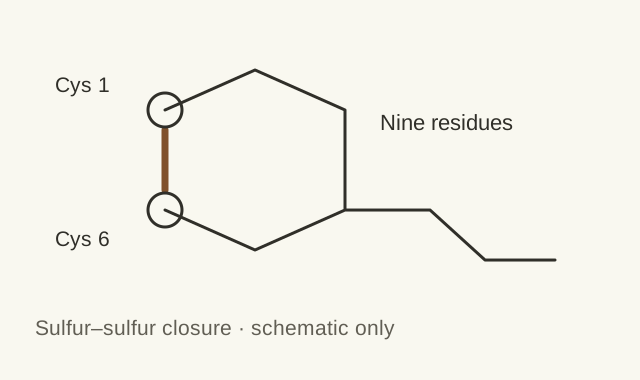
The earlier profile describes the nine-residue arginine vasopressin sequence shown above. A disulfide bridge joins the sulfur atoms of cysteine residues 1 and 6. The intended ring and terminal amide are parts of the molecular identity.
Vasopressin has FDA-approved drug products in specific forms. Approval belongs to those products and their authorised manufacturing and labelling, not to any research material carrying the same compound name.
How the chain is assembled
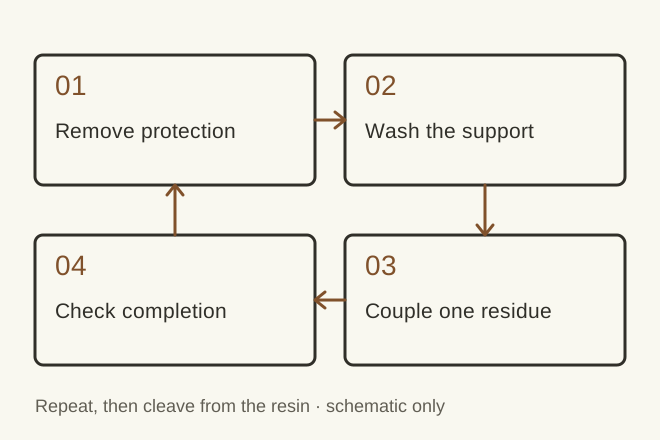
The described Fmoc (a temporary chemical protecting group) route builds the protected linear chain on an amide-forming support. Cleavage releases the chain and removes side-chain protection. The manufacturing record needs to distinguish this linear intermediate from the closed product.
Oxidation then forms the disulfide bond. The earlier account compares air oxidation with alternative oxidation methods. Conditions affect the balance between the intended ring, dimers and other by-products, so closure needs analytical confirmation rather than an assumed completion time.
What purification must separate
The older route uses primary reversed-phase separation and a later polishing step to remove incomplete chains, oxidation products, dimers and residues. Fraction identity and purity are both relevant to deciding what enters the pool.
Method development needs to show that the intended cyclic product is resolved from the species of concern. Column loading, solvent gradient and collection windows are linked choices. The inherited numerical examples do not establish a validated separation.
What release testing can establish
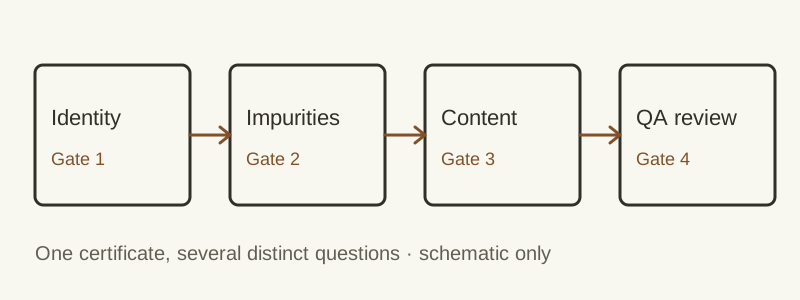
The earlier panel combines HPLC, mass spectrometry and amino acid analysis. Mass helps confirm the expected form, while composition and related-substance testing add information that a mass result alone cannot supply. Peptide content corrects for non-peptide material.
Water, residual solvents, elemental impurities, endotoxin and any sterility claim require separate results. A chromatogram should identify the method and its ability to separate relevant impurities. A generic passing purity result is not the complete release record.
Where stability can be lost
The old account highlights oxidation around tyrosine and sulfur-containing residues, alongside other chemical changes under stress. Stability studies need methods that distinguish those products from the intended ring. Temperature, light and the container influence the study design.
Powder storage, shipping and monitoring remain manufacturing topics. A finished drug product’s handling requirements belong to its own authorised instructions and cannot be transferred to research material.
What the batch record must show
The manufacturing record should trace the linear intermediate, oxidation step, selected purification fractions and final identity results. Raw-material lots, calibration, deviations and quality approval connect the record to a released batch. Scale-up needs evidence for mixing and separation, with changes assessed through the quality system.
The original citations below are retained, including general FDA and ICH manufacturing guidance. They provide documentation context, not approval of research supply. The final certificate should identify the exact molecular form and the batch actually tested.
Technical tables & working schedules
Vasopressin tables retain the earlier manufacturing examples. No Vasopressin table here validates an operating procedure, release limit or supplier result. The Vasopressin examples have no supporting batch raw data; use them to identify document fields, not to infer measured performance.
Resin Loading and Synthesis Parameters9 rows
Inherited manufacturing example. Vasopressin settings in this table are unvalidated examples, not supplier specifications or batch results. The Vasopressin process and its measurement methods need separate qualification.
| Position | Amino Acid | Protected Form | Coupling Time (min) | Critical Parameters |
|---|---|---|---|---|
| 9 (C-term) | Gly-NH₂ | Fmoc-Gly-OH on Rink Amide | 45-60 | Resin pre-swelling, complete loading |
| 8 | Arg | Fmoc-Arg(Pbf)-OH | 60-90 | Extended coupling, guanidine protection |
| 7 | Pro | Fmoc-Pro-OH | 90-120 | Secondary amine, double coupling |
| 6 | Cys | Fmoc-Cys(Trt)-OH | 60-90 | Trityl protection, disulfide precursor |
| 5 | Asn | Fmoc-Asn(Trt)-OH | 60-90 | Prevent deamidation, side-chain protection |
| 4 | Gln | Fmoc-Gln(Trt)-OH | 60-90 | Prevent deamidation, side-chain protection |
| 3 | Phe | Fmoc-Phe-OH | 45-60 | Hydrophobic residue aggregation risk |
| 2 | Tyr | Fmoc-Tyr(tBu)-OH | 60-90 | Phenol protection, oxidation sensitivity |
| 1 (N-term) | Cys | Fmoc-Cys(Trt)-OH | 60-90 | Disulfide precursor, final coupling |
Alternative Oxidation Methods4 rows
Inherited manufacturing example. Vasopressin settings in this table are unvalidated examples, not supplier specifications or batch results. The Vasopressin process and its measurement methods need separate qualification.
| Oxidation Method | Reaction Time | Cyclization Yield | Dimer Formation | Production Suitability |
|---|---|---|---|---|
| Air oxidation (pH 8.0) | 24-72 hours | 75-85% | 8-15% | High (standard method) |
| DMSO oxidation | 6-24 hours | 80-90% | 5-10% | High (faster processing) |
| Iodine oxidation | 0.5-1 hour | 70-80% | 10-15% | Moderate (requires additional purification) |
| Ferricyanide oxidation | 2-4 hours | 65-75% | 15-20% | Low (metal contamination risk) |
Amino Acid Analysis8 rows
Inherited manufacturing example. Vasopressin settings in this table are unvalidated examples, not supplier specifications or batch results. The Vasopressin process and its measurement methods need separate qualification.
| Amino Acid | Theoretical Ratio | Acceptable Range | Analytical Considerations |
|---|---|---|---|
| Cys (as cysteic acid) | 2.0 | 1.8-2.2 | Performic acid pre-oxidation required |
| Tyr | 1.0 | 0.9-1.1 | Reference residue (stable) |
| Phe | 1.0 | 0.9-1.1 | Stable under hydrolysis |
| Gln (as Glu) | 1.0 | 0.9-1.1 | Complete conversion to Glu during hydrolysis |
| Asn (as Asp) | 1.0 | 0.9-1.1 | Complete conversion to Asp during hydrolysis |
| Pro | 1.0 | 0.9-1.1 | Imino acid, special detection requirements |
| Arg | 1.0 | 0.9-1.1 | Stable under standard conditions |
| Gly | 1.0 | 0.9-1.1 | Stable, smallest amino acid |
Batch Manufacturing Specifications and Release Criteria20 rows
Inherited manufacturing example. Vasopressin settings in this table are unvalidated examples, not supplier specifications or batch results. The Vasopressin process and its measurement methods need separate qualification.
| Test Parameter | Specification | Test Method | Acceptance Criteria |
|---|---|---|---|
| Appearance | White to off-white lyophilized powder | Visual inspection | Conforms to description |
| Solubility | Freely soluble in water | Visual observation at 10 mg/mL | Clear colorless solution |
| Identity (HPLC) | Retention time matches reference | RP-HPLC, UV 214 nm | RT ± 2% of reference standard |
| Identity (MS) | Molecular weight 1084.23 ± 0.5 Da | ESI-MS or MALDI-TOF MS | [M+H]⁺ = 1084.4 ± 0.5 |
| Purity (HPLC) | ≥97.0% | RP-HPLC, UV 214 nm | Single main peak ≥97.0% area |
| Des-Arg impurity | ≤1.5% | RP-HPLC, UV 214 nm | Individual impurity ≤1.5% |
| Linear vasopressin | ≤2.0% | RP-HPLC, UV 214 nm | Individual impurity ≤2.0% |
| Dimers/oligomers | ≤2.0% | RP-HPLC, UV 214 nm | Combined total ≤2.0% |
| Any unspecified impurity | ≤0.5% | RP-HPLC, UV 214 nm | Each impurity ≤0.5% |
| Total impurities | ≤3.0% | RP-HPLC, UV 214 nm | Sum of all impurities ≤3.0% |
| Amino acid composition | Conforms to theory ± 10% | AAA after HCl hydrolysis | All residues within ±10% |
| Peptide content | ≥85.0% (dry basis) | Quantitative AAA or UV | ≥85.0% by weight |
| Water content | ≤10.0% | Karl Fischer titration | ≤10.0% w/w |
| TFA content | ≤1.0% | Ion chromatography or ¹⁹F NMR | ≤1.0% w/w |
| Acetonitrile | ≤410 ppm | GC headspace | Meets ICH Q3C limit |
| Residual solvents | Per ICH Q3C | GC-FID | All solvents within limits |
| Heavy metals (Pd) | ≤10 ppm | ICP-MS | ≤10 ppm |
| Bacterial endotoxins | ≤10.0 EU/mg | LAL assay (USP <85>) | ≤10.0 EU/mg |
| Bioburden (if non-sterile) | ≤100 CFU/g | USP <61> and <62> | Total aerobic count ≤100 CFU/g |
| Sterility (if sterile) | Sterile | USP <71> | No growth observed |
Stability Study Design5 rows
Inherited manufacturing example. Vasopressin settings in this table are unvalidated examples, not supplier specifications or batch results. The Vasopressin process and its measurement methods need separate qualification.
| Storage Condition | HPLC Purity After 12 Months | Major Degradation Products | Recommendations |
|---|---|---|---|
| -20°C, desiccated | >98% | Minimal degradation | Preferred long-term storage |
| 2-8°C, desiccated | 97-98% | Trace oxidation, deamidation | Acceptable for 24+ months |
| 25°C/60% RH | 95-97% | Oxidation (3-5%), deamidation (2-3%) | Maximum 12-18 months |
| 40°C/75% RH (6 months) | 90-94% | Oxidation (5-7%), deamidation (3-5%) | Not recommended |
| Solution stability evidence | Not published | Not published | Not published |
Source register
Vasopressin source links are retained below. These references give context for Vasopressin manufacturing; they do not validate the numerical examples. Duplicate Vasopressin source links retain the citation record.
- Chan, W. C., & White, P. D. (Eds.). (2000). Fmoc Solid Phase Peptide Synthesis: A Practical Approach. Oxford University Press. https://doi.org/10.1093/oso/9780199637256.001.0001
- Moroder, L., & Musiol, H. J. (2017). Insulin—from its discovery to the industrial synthesis of modern insulin analogues. Angewandte Chemie International Edition, 56(36), 10656-10669. https://doi.org/10.1002/anie.201702493
- Bouchard, M., Zurdo, J., Nettleton, E. J., Dobson, C. M., & Robinson, C. V. (2000). Formation of insulin amyloid fibrils followed by FTIR simultaneously with CD and electron microscopy. Protein Science, 9(10), 1960-1967. https://doi.org/10.1110/ps.9.10.1960
- Manning, M. C., Patel, K., & Borchardt, R. T. (1989). Stability of protein pharmaceuticals. Pharmaceutical Research, 6(11), 903-918. https://doi.org/10.1023/A:1015929109894
- ICH Q7. (2000). Good Manufacturing Practice Guide for Active Pharmaceutical Ingredients. International Council for Harmonisation of Technical Requirements for Pharmaceuticals for Human Use. https://www.ich.org/page/quality-guidelines
- Collins, J. M., Porter, K. A., Singh, S. K., & Vanier, G. S. (2014). High-efficiency solid phase peptide synthesis (HE-SPPS). Organic Letters, 16(3), 940-943. https://doi.org/10.1021/ol4036825
- Behrendt, R., White, P., & Offer, J. (2016). Advances in Fmoc solid-phase peptide synthesis. Journal of Peptide Science, 22(1), 4-27. https://doi.org/10.1002/psc.2836
- Coin, I., Beyermann, M., & Bienert, M. (2007). Solid-phase peptide synthesis: from standard procedures to the synthesis of difficult sequences. Nature Protocols, 2(12), 3247-3256. https://doi.org/10.1038/nprot.2007.454
- Amblard, M., Fehrentz, J. A., Martinez, J., & Subra, G. (2006). Methods and protocols of modern solid phase peptide synthesis. Molecular Biotechnology, 33(3), 239-254. https://doi.org/10.1385/MB:33:3:239
- Henninot, A., Collins, J. C., & Nuss, J. M. (2018). The current state of peptide drug discovery: Back to the future? Journal of Medicinal Chemistry, 61(4), 1382-1414. https://doi.org/10.1021/acs.jmedchem.7b00318