What has to be made
The earlier profile gives full-length thymosin beta-4 as a 43-residue, N-terminally acetylated peptide. It is distinct from the LKKTETQ fragment discussed on the TB-500 page. Sequence length, terminal groups and the exact molecular form should be explicit in the record.
The older text discusses both acid and amide routes. Those describe different terminal structures; they are not interchangeable manufacturing options for one unchanged identity specification. The table values remain inherited examples requiring form-specific review.
How the chain is assembled
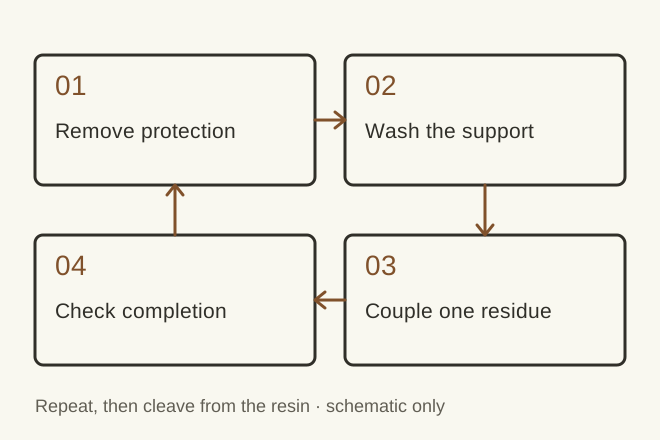
The Fmoc (a temporary chemical protecting group) route repeatedly joins protected residues on a support. Over a longer chain, aggregation and incomplete coupling can affect access to the reactive end. The earlier account discusses resin loading, reaction checks and management of difficult segments.
N-terminal acetylation and final cleavage introduce additional checkpoints. Crude analysis helps explain whether the process produced the intended full-length material or a mixture of shortened and altered chains. A successful instrument run is not a sequence certificate.
What purification must separate
Multi-stage RP-HPLC (reversed-phase high-performance liquid chromatography, which separates mixture components) separates the full-length target from related peptides. Fraction testing and identity confirmation determine what can be pooled. The earlier gradient and collection examples need equipment- and material-specific development.
Desalting, counterion exchange and freeze-drying affect final composition and physical form. Moisture, salts and excipients all contribute to total weight. The appendix retains a manufacturing-formulation example; its per-vial amounts are not a human dosing schedule.
What release testing can establish
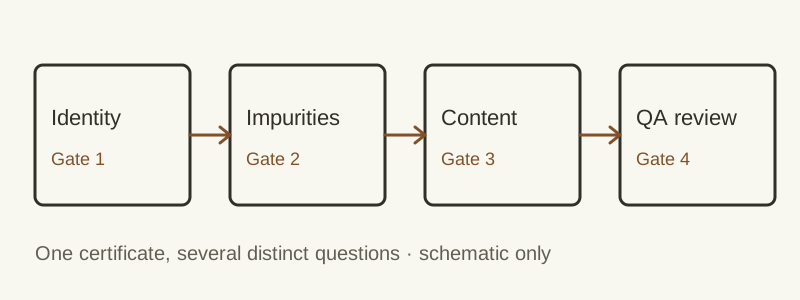
The earlier panel combines mass, HPLC, composition and peptide-content measurements. Larger species can require separate methods from the main reversed-phase purity assay. Individual related substances and total impurity levels should be interpreted with the method’s ability to resolve them.
Residual-solvent, water, counterion and microbial results answer other release questions. The sample certificate and stability-result tables are illustrative records from the earlier page. They are not verified measurements or evidence of a supplier’s batch quality.
Where stability can be lost
The older discussion identifies oxidation, deamidation and aggregation as concerns for study. A formulation programme examines excipient compatibility and changes under stress, while long-term data support storage claims for the actual container.
The powder-storage and shipping topics remain. Example stability figures cannot establish a shelf life for another form, container or formulation.
What the batch record must show
Raw-material controls, process qualification, cleaning, deviations and change control support the batch history. A release certificate should connect actual results to the stated full-length form and to the executed manufacturing record. Supplier qualification and quality agreements address the upstream chain.
Full-length identity must stay distinct from a fragment’s name or specification. The FDA correction concerning the LKKTETQ fragment must not be applied automatically to this full-length peptide.
Technical tables & working schedules
Thymosin beta-4 tables retain the earlier manufacturing examples. No Thymosin beta-4 table here validates an operating procedure, release limit or supplier result. The Thymosin beta-4 examples have no supporting batch raw data; use them to identify document fields, not to infer measured performance.
Coupling and Deprotection Cycles5 rows
Inherited manufacturing example. Thymosin beta-4 settings in this table are unvalidated examples, not supplier specifications or batch results. The Thymosin beta-4 process and its measurement methods need separate qualification. Acid and amide forms require different terminal specifications; the earlier alternatives do not describe one unchanged target.
| Step | Reagent/Condition | Duration | Purpose |
|---|---|---|---|
| Fmoc Deprotection | 20% piperidine in DMF | 2 × 5 min | Remove N-terminal Fmoc protecting group |
| DMF Wash | DMF (5 resin volumes) | 6 × 30 sec | Remove piperidine and dibenzofulvene |
| Amino Acid Coupling | Fmoc-AA (4 eq), HBTU (3.95 eq), HOBt (4 eq), DIPEA (8 eq) | 45-60 min | Form peptide bond |
| DMF Wash | DMF (5 resin volumes) | 6 × 30 sec | Remove excess reagents |
| Capping (if needed) | Ac2O (5%), DIPEA (10%) in DMF | 5 min | Block unreacted amine groups |
Preparative RP-HPLC Methodology7 rows
Inherited manufacturing example. Thymosin beta-4 settings in this table are unvalidated examples, not supplier specifications or batch results. The Thymosin beta-4 process and its measurement methods need separate qualification.
| Parameter | Specification | Notes |
|---|---|---|
| Mobile Phase A | 0.1% TFA in water (HPLC grade) | pH ~2.0 for optimal peptide ionization |
| Mobile Phase B | 0.1% TFA in acetonitrile (HPLC grade) | Organic modifier for peptide elution |
| Gradient Profile | 20-45% B over 40 min | Optimized for Tβ4 hydrophobicity |
| Flow Rate | 20 mL/min (preparative) | Scaled for column dimensions |
| Column Temperature | 40°C | Improved peak shape and resolution |
| Detection Wavelength | 214 nm and 280 nm | Peptide bond and aromatic residues |
| Injection Volume | 5-10 mL (preparative) | Dissolved in 10-20% B |
Purity Assessment by HPLC8 rows
Inherited manufacturing example. Thymosin beta-4 settings in this table are unvalidated examples, not supplier specifications or batch results. The Thymosin beta-4 process and its measurement methods need separate qualification.
| HPLC Parameter | Specification |
|---|---|
| Mobile Phase A | 0.1% TFA in water |
| Mobile Phase B | 0.1% TFA in acetonitrile |
| Gradient | 15-55% B over 30 min |
| Flow Rate | 1.0 mL/min |
| Column Temperature | 40°C |
| Detection | 214 nm (quantification), 280 nm (identity) |
| Injection Volume | 20 μL (0.5-1.0 mg/mL) |
| Run Time | 45 min (including re-equilibration) |
Amino Acid Analysis11 rows
Inherited manufacturing example. Thymosin beta-4 settings in this table are unvalidated examples, not supplier specifications or batch results. The Thymosin beta-4 process and its measurement methods need separate qualification.
| Amino Acid | Theoretical | Acceptable Range |
|---|---|---|
| Alanine (Ala) | 2 | 1.90-2.10 |
| Aspartic Acid + Asparagine (Asx) | 2 | 1.90-2.10 |
| Glutamic Acid + Glutamine (Glx) | 8 | 7.70-8.30 |
| Serine (Ser) | 3 | 2.70-3.30 |
| Lysine (Lys) | 6 | 5.70-6.30 |
| Threonine (Thr) | 3 | 2.70-3.30 |
| Proline (Pro) | 3 | 2.70-3.30 |
| Isoleucine (Ile) | 2 | 1.90-2.10 |
| Leucine (Leu) | 1 | 0.90-1.10 |
| Methionine (Met) | 1 | 0.85-1.15* |
| Phenylalanine (Phe) | 1 | 0.90-1.10 |
Pharmaceutical-Grade Product Specifications12 rows
Inherited manufacturing example. Thymosin beta-4 settings in this table are unvalidated examples, not supplier specifications or batch results. The Thymosin beta-4 process and its measurement methods need separate qualification.
| Test | Method | Acceptance Criteria |
|---|---|---|
| Appearance | Visual inspection | White to off-white lyophilized powder |
| Identity (HPLC) | Analytical RP-HPLC | Retention time matches reference standard ± 2% |
| Identity (MS) | ESI-MS or MALDI-TOF | Observed mass: 4963.55 ± 2.5 Da |
| Purity (HPLC) | Analytical RP-HPLC | ≥95.0% (area percentage) |
| Single Largest Impurity | Analytical RP-HPLC | ≤2.0% |
| Amino Acid Composition | AAA (post-hydrolysis) | Conforms to theoretical ± 10% |
| Peptide Content | AAA with moisture correction | ≥80.0% (dry weight basis) |
| Water Content | Karl Fischer titration | ≤8.0% |
| Residual TFA | Ion chromatography or ¹⁹F NMR | ≤0.5% (for HCl salt) or Report (for TFA salt) |
| Bacterial Endotoxin | LAL assay (USP <85>) | ≤10 EU/mg |
| Sterility (if applicable) | USP <71> or Ph. Eur. 2.6.1 | No growth |
| Heavy Metals | ICP-MS | ≤10 ppm total; individual metals per ICH Q3D |
Stability Testing Protocol6 rows
Inherited manufacturing example. Thymosin beta-4 settings in this table are unvalidated examples, not supplier specifications or batch results. The Thymosin beta-4 process and its measurement methods need separate qualification.
| Study Type | Storage Condition | Duration | Testing Frequency |
|---|---|---|---|
| Long-term | -20°C ± 5°C | 36 months | 0, 6, 12, 18, 24, 36 months |
| Accelerated | 5°C ± 3°C | 12 months | 0, 3, 6, 9, 12 months |
| Intermediate | 25°C ± 2°C / 60% RH ± 5% | 6 months | 0, 1, 2, 3, 6 months |
| Stress (Temperature) | 40°C ± 2°C / 75% RH ± 5% | 3 months | 0, 1, 2, 3 months |
| Stress (Light) | ICH Q1B photostability | Single exposure | Post-exposure analysis |
| Freeze-Thaw | -80°C to 25°C cycles | 5 cycles | After each cycle |
Stability Data Summary8 rows
Illustrative record retained from the earlier edition. These Thymosin beta-4 examples have no verified measurement dataset and cannot establish a batch result or supplier performance.
| Storage Condition | Time Point | Purity by HPLC (%) | Primary Impurity | Moisture (%) |
|---|---|---|---|---|
| -20°C (Initial) | 0 months | 97.8 | 0.8 (des-Ser¹) | 4.2 |
| -20°C | 12 months | 97.4 | 1.0 (Met-ox) | 4.5 |
| -20°C | 24 months | 96.9 | 1.3 (Met-ox) | 4.8 |
| -20°C | 36 months | 96.2 | 1.6 (Met-ox) | 5.1 |
| 5°C | 6 months | 96.5 | 1.5 (Met-ox) | 4.9 |
| 5°C | 12 months | 95.8 | 2.0 (Met-ox) | 5.4 |
| 25°C/60% RH | 3 months | 95.2 | 2.3 (Met-ox) | 6.2 |
| 25°C/60% RH | 6 months | 93.8 | 3.1 (Met-ox + deamidation) | 6.8 |
Representative Certificate of Analysis22 rows
Illustrative record retained from the earlier edition. These Thymosin beta-4 examples have no verified measurement dataset and cannot establish a batch result or supplier performance.
| Test | Specification | Result | Method |
|---|---|---|---|
| Physical Properties | |||
| Appearance | White to off-white powder | White lyophilized powder | Visual |
| Solubility | Soluble in water and dilute acid | Conforms | Visual |
| Identity | |||
| HPLC Retention Time | Matches reference ± 2% | 15.8 min (ref: 15.7 min) | RP-HPLC |
| Mass Spectrometry | 4963.55 ± 2.5 Da | 4963.8 Da [M+H]⁺ | ESI-MS |
| Amino Acid Analysis | Conforms to theoretical ± 10% | Conforms | AAA (6N HCl hydrolysis) |
| Purity | |||
| Purity (HPLC) | ≥95.0% | 97.8% | RP-HPLC (214 nm) |
| Single Largest Impurity | ≤2.0% | 0.8% (des-Ser¹) | RP-HPLC (214 nm) |
| Assay | |||
| Peptide Content | ≥80.0% | 88.5% | AAA (dry weight basis) |
| Water Content | ≤8.0% | 4.2% | Karl Fischer |
| Acetate Content | Report | 7.3% | Ion chromatography |
| Impurities | |||
| Residual TFA | ≤0.5% | <0.1% | Ion chromatography |
| Residual Solvents (DMF) | ≤50 ppm | <10 ppm | GC-MS |
| Residual Solvents (Acetonitrile) | ≤410 ppm | <20 ppm | GC-MS |
| Heavy Metals (Total) | ≤10 ppm | <5 ppm | ICP-MS |
| Microbiological | |||
| Bacterial Endotoxin | ≤10 EU/mg | <2 EU/mg | LAL (USP <85>) |
| Bioburden (if non-sterile) | ≤100 CFU/g | <10 CFU/g | USP <61> |
Representative Lyophilized Formulation6 rows
Inherited manufacturing example. Thymosin beta-4 settings in this table are unvalidated examples, not supplier specifications or batch results. The Thymosin beta-4 process and its measurement methods need separate qualification.
| Component | Amount per Vial | Function |
|---|---|---|
| Thymosin Beta-4 (acetate salt) | 5.0 mg | Active pharmaceutical ingredient |
| Mannitol | 25 mg | Bulking agent, cryoprotectant |
| Trehalose dihydrate | 10 mg | Lyoprotectant, stabilizer |
| Sodium acetate buffer | 2 mg | pH buffer (pH 5.5) |
| Acetic acid | q.s. to pH 5.5 | pH adjustment |
| Polysorbate 80 | 0.05 mg | Surfactant, anti-aggregation |
Source register
Thymosin beta-4 source links are retained below. These references give context for Thymosin beta-4 manufacturing; they do not validate the numerical examples. Duplicate Thymosin beta-4 source links retain the citation record.
- Goldstein AL, Hannappel E, Kleinman HK. Thymosin β4: actin-sequestering protein moonlights to repair injured tissues. Trends Mol Med. 2005;11(9):421-429. doi:10.1016/j.molmed.2005.07.004 - https://pubmed.ncbi.nlm.nih.gov/16099219/
- International Conference on Harmonisation. ICH Q7: Good Manufacturing Practice Guide for Active Pharmaceutical Ingredients. 2000. https://www.ich.org/page/quality-guidelines
- Erickson-Viitanen S, Horecker BL. The cytoplasmic actin-sequestering peptide thymosin beta 4: isolation and amino acid sequence. Methods Enzymol. 1986;128:276-284. doi:10.1016/0076-6879(86)28073-x - https://pubmed.ncbi.nlm.nih.gov/3724516/
- García-Martín F, Quintanar-Audelo M, García-Ramos Y, et al. ChemMatrix, a poly(ethylene glycol)-based support for the solid-phase synthesis of complex peptides. J Comb Chem. 2006;8(2):213-220. doi:10.1021/cc0600019 - https://pubmed.ncbi.nlm.nih.gov/16529516/
- United States Pharmacopeia. General Chapter <621> Chromatography. USP 44-NF 39. 2021. https://www.usp.org/
- Rutherfurd SM, Gilani GS. Amino acid analysis. Curr Protoc Protein Sci. 2009;Chapter 11:Unit 11.9. doi:10.1002/0471140864.ps1109s58 - https://pubmed.ncbi.nlm.nih.gov/19842108/
- International Conference on Harmonisation. ICH Q6A: Specifications: Test Procedures and Acceptance Criteria for New Drug Substances and New Drug Products: Chemical Substances. 1999. https://www.ich.org/page/quality-guidelines
- International Conference on Harmonisation. ICH Q6B: Specifications: Test Procedures and Acceptance Criteria for Biotechnological/Biological Products. 1999. https://www.ich.org/page/quality-guidelines
- International Conference on Harmonisation. ICH Q1A(R2): Stability Testing of New Drug Substances and Products. 2003. https://www.ich.org/page/quality-guidelines
- Manning MC, Chou DK, Murphy BM, Payne RW, Katayama DS. Stability of protein pharmaceuticals: an update. Pharm Res. 2010;27(4):544-575. doi:10.1007/s11095-009-0045-6 - https://pubmed.ncbi.nlm.nih.gov/20143256/
- U.S. Food and Drug Administration. Code of Federal Regulations Title 21, Parts 210 and 211: Current Good Manufacturing Practice in Manufacturing, Processing, Packing, or Holding of Drugs. https://www.fda.gov/drugs/pharmaceutical-quality-resources/current-good-manufacturing-practice-cgmp-regulations
- International Conference on Harmonisation. ICH Q8, Q9, Q10: Pharmaceutical Development, Quality Risk Management, and Pharmaceutical Quality System. https://www.ich.org/page/quality-guidelines