What has to be made
The earlier profile describes a 44-amino-acid growth hormone-releasing hormone analogue with an N-terminal trans-3-hexenoyl group. That modification is part of the intended identity. The unmodified chain and the modified target need to be distinguished.
The old text contains manufacturing and pharmaceutical-development examples. Those examples do not make research material equivalent to an authorised finished product. The retained numerical tables are unvalidated reference material.
How the chain is assembled
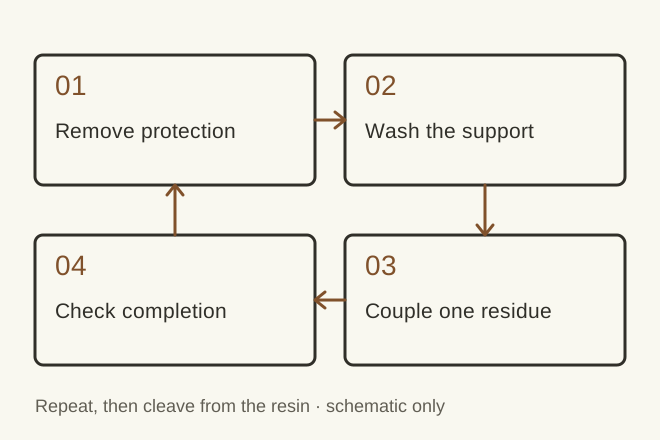
Fmoc (a temporary chemical protecting group) solid-phase peptide synthesis builds the longer chain on a support selected for the terminal structure. Aggregation can make reaction sites less accessible, so coupling completion and deprotection monitoring become important over repeated cycles. The earlier account discusses alternative building-block and process approaches to difficult segments.
The terminal hexenoylation step follows chain assembly in that route. Cleavage, deprotection and crude recovery then require analysis for incomplete chains, altered residues and modification-related material. The record needs evidence for the full intended form, not just a completed synthesiser run.
What purification must separate
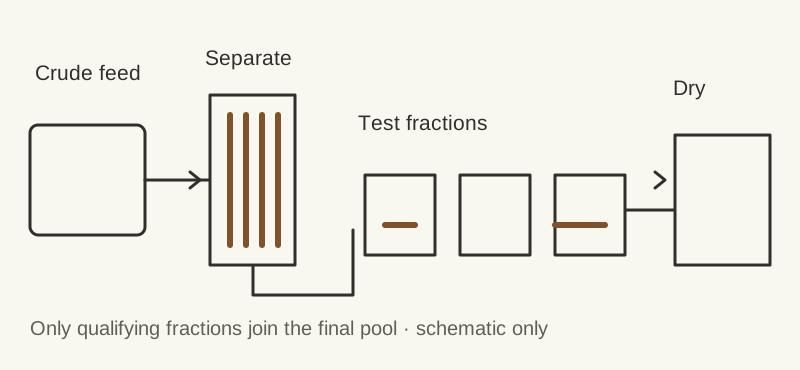
The older RP-HPLC (reversed-phase high-performance liquid chromatography, which separates mixture components) strategy balances separation against loading and recovery. Analytical scouting identifies close impurities before a preparative method is scaled. Each fraction needs a reason to enter or stay out of the pool.
Desalting and solvent removal precede formulation and freeze-drying. Excipients are ingredients added for processing or stability; their contribution should be separated from peptide content. Filling, drying, stoppering and container-closure tests require their own qualified controls.
What release testing can establish
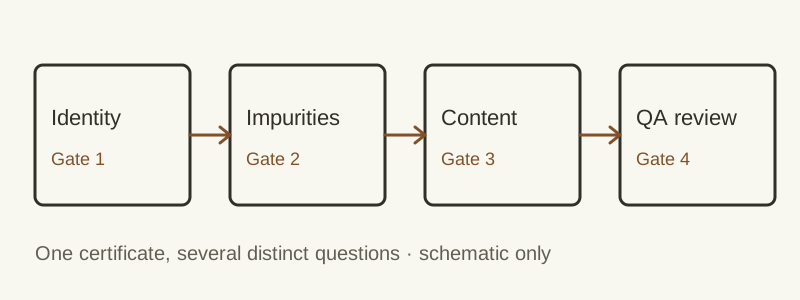
The earlier quality panel includes identity, several chromatographic modes, content, impurity profiling and physical testing. Orthogonal methods use different principles to make it harder for one analytical blind spot to determine the whole conclusion.
The example per-vial content figures below are manufacturing fill examples, not dosing instructions. Residual solvents, water, counterions, microbial tests and actual content need measured results for the batch. A sample certificate cannot supply those results.
Where stability can be lost
The older stability programme examines degradation pathways, packaging, temperature, light and ongoing monitoring. Glass transition and collapse measurements help develop a drying cycle; they are not by themselves long-term stability evidence.
The relevant study follows the actual formulation and closure system over time. A research powder cannot inherit a finished drug’s storage conditions merely because the compound name is familiar.
What the batch record must show
The master record should connect all raw-material lots and processing stages with final analytical data. Yield reconciliation, deviations, corrective action and independent quality review explain why a batch was released. Continued monitoring is needed after a process has been qualified.
The intended molecular form and actual analytical results remain the relevant evidence. Pharmaceutical quality-system language and regulatory filing support remain documentation topics, not a statement of approval for the material being discussed.
Technical tables & working schedules
Tesamorelin tables retain the earlier manufacturing examples. No Tesamorelin table here validates an operating procedure, release limit or supplier result. The Tesamorelin examples have no supporting batch raw data; use them to identify document fields, not to infer measured performance.
Amino Acid Coupling Strategy6 rows
Inherited manufacturing example. Tesamorelin settings in this table are unvalidated examples, not supplier specifications or batch results. The Tesamorelin process and its measurement methods need separate qualification.
| Parameter | Specification | Monitoring Method |
|---|---|---|
| Amino Acid Equivalents | 3-5 equivalents (5 for difficult sequences) | Gravimetric verification |
| Activator Equivalents | 3-5 equivalents HBTU/HOBt | Solution preparation verification |
| Base Equivalents | 6-10 equivalents DIEA | Volumetric measurement |
| Coupling Time | 60-120 minutes (double coupling for Arg, His) | Automated timer validation |
| Reaction Temperature | 25°C ± 3°C (elevated to 40°C for difficult couplings) | Continuous temperature recording |
| Coupling Efficiency | ≥99.5% by Kaiser or chloranil test | Colorimetric assay after each coupling |
Cleavage Procedure and Parameters5 rows
Inherited manufacturing example. Tesamorelin settings in this table are unvalidated examples, not supplier specifications or batch results. The Tesamorelin process and its measurement methods need separate qualification.
| Parameter | Specification | Quality Impact |
|---|---|---|
| Cleavage Cocktail Volume | 15-20 mL per gram of resin | Adequate scavenger capacity and mixing |
| Reaction Temperature | 20-25°C (room temperature) | Minimize oxidation and sequence deletion |
| Reaction Duration | 2.5-4.0 hours with periodic mixing | Complete deprotection without excessive degradation |
| Mixing Frequency | Every 30 minutes by manual agitation | Homogeneous exposure to cleavage reagents |
| Vessel Type | Glass reaction vessel with cap (pressure release) | Containment of CO₂ from tBu/Pbf deprotection |
Gradient Method Development6 rows
Inherited manufacturing example. Tesamorelin settings in this table are unvalidated examples, not supplier specifications or batch results. The Tesamorelin process and its measurement methods need separate qualification.
| Time (min) | %B | Flow Rate (mL/min) | Phase Description |
|---|---|---|---|
| 0-5 | 30 | 50-100 | Initial equilibration, sample loading |
| 5-10 | 30-35 | 50-100 | Wash highly polar impurities, truncations |
| 10-50 | 35-45 | 50-100 | Shallow gradient for critical separation region |
| 50-60 | 45-95 | 50-100 | Steep gradient to elute hydrophobic impurities |
| 60-65 | 95 | 50-100 | Column wash, removal of strongly retained material |
| 65-75 | 95-30 | 50-100 | Re-equilibration for next injection |
Vial Filling and Stopper Placement7 rows
Inherited manufacturing example. Tesamorelin settings in this table are unvalidated examples, not supplier specifications or batch results. The Tesamorelin process and its measurement methods need separate qualification.
| Parameter | Specification | Quality Control |
|---|---|---|
| Vial Type | Type I borosilicate glass, 5-10 mL capacity | Certificate of conformance from supplier |
| Vial Preparation | Depyrogenated at 250°C for 30 minutes | LAL testing of rinse water <0.25 EU/mL |
| Stopper Type | Bromobutyl or chlorobutyl rubber, coated | Extractables/leachables qualification |
| Fill Volume | 2.0-3.0 mL (overfill to account for lyophilization loss) | Gravimetric verification every 10-20 vials |
| Fill Volume Accuracy | ±5% of target volume | In-process weight checks with statistical control |
| Stopper Placement | Partially seated (2-3 mm above full seal position) | Visual verification, allows vapor escape |
| Particulate Matter | Zero visible particles per USP <790> | 100% visual inspection under controlled lighting |
Content and Potency Determination4 rows
Inherited manufacturing example. Tesamorelin settings in this table are unvalidated examples, not supplier specifications or batch results. The Tesamorelin process and its measurement methods need separate qualification.
| Method | Principle | Specification |
|---|---|---|
| Quantitative RP-HPLC | External standard calibration curve (5 points, 0.5-2.0 mg/mL) | Not published |
| UV Spectroscopy | Absorbance at 280 nm using calculated extinction coefficient | Confirmatory method, ±15% agreement with HPLC |
| Amino Acid Analysis | Quantitative AAA vs. calibrated amino acid standards | Supporting method for peptide content verification |
| Nitrogen Determination | Kjeldahl or combustion analysis (CHNS analyzer) | Alternative quantitation, nitrogen content 19.2-20.8% |
In-Process Control Testing Strategy7 rows
Inherited manufacturing example. Tesamorelin settings in this table are unvalidated examples, not supplier specifications or batch results. The Tesamorelin process and its measurement methods need separate qualification.
| Manufacturing Stage | In-Process Test | Acceptance Criteria | Action on Failure |
|---|---|---|---|
| SPPS - Each Coupling | Kaiser (ninhydrin) test | Negative (no blue color, free amine consumed) | Repeat coupling until negative result |
| SPPS - Each Deprotection | UV monitoring at 301 nm | Return to baseline (complete Fmoc removal) | Extend deprotection time, retest |
| Hexenoylation | Test cleavage with MS analysis | ≥95% hexenoylation (MW 5135.9 Da) | Continue reaction, retest at intervals |
| Crude Peptide | Analytical HPLC and MS | Not published | Proceed to purification (low purity acceptable for crude) |
| Purification Fractions | Analytical HPLC purity | ≥95% for pooling, 85-95% for repurification | Segregate fractions, reprocess or reject |
| Pre-Lyophilization Solution | Bioburden, pH, appearance | <10 CFU/100 mL, pH 6.0-7.5, clear | Re-filter (bioburden), adjust pH, clarify |
| Post-Lyophilization | Residual moisture | ≤3.0% by Karl Fischer | Extend secondary drying if possible, or reject |
Stability-Indicating Analytical Test Panel10 rows
Inherited manufacturing example. Tesamorelin settings in this table are unvalidated examples, not supplier specifications or batch results. The Tesamorelin process and its measurement methods need separate qualification.
| Test | Method | Release Specification | Shelf-Life Specification |
|---|---|---|---|
| Appearance | Visual inspection | White to off-white lyophilized cake | White to off-white, no significant discoloration |
| Identification (HPLC) | RP-HPLC retention time | Matches reference standard ±2% | Matches reference standard ±2% |
| Identification (MS) | ESI-MS molecular weight | 5135.9 ± 1.0 Da | 5135.9 ± 1.0 Da |
| Purity (RP-HPLC) | RP-HPLC at 214 nm | ≥95.0% | ≥92.0% |
| Assay (Content) | Quantitative HPLC | 90.0-110.0% of label claim | 85.0-115.0% of label claim |
| Water Content | Karl Fischer titration | ≤3.0% | ≤5.0% |
| Aggregates | SEC-HPLC | ≤3.0% | ≤5.0% |
| Met Oxidation | RP-HPLC peak tracking | ≤1.5% (Met-sulfoxide peak) | ≤3.0% |
| Deamidation | Ion-exchange HPLC or RP-HPLC | ≤2.0% | ≤4.0% |
| pH (reconstituted) | pH meter (1% solution) | 6.0-7.5 | 5.5-8.0 |
Environmental Monitoring and Temperature Control4 rows
Inherited manufacturing example. Tesamorelin settings in this table are unvalidated examples, not supplier specifications or batch results. The Tesamorelin process and its measurement methods need separate qualification.
| Storage Area | Monitoring Parameters | Recording Frequency | Alarm Limits |
|---|---|---|---|
| Freezer (-20°C) | Temperature (validated probe) | Continuous recording, 10-15 min intervals | Alert: -23°C or -17°CAction: -25°C or -15°C |
| Refrigerator (2-8°C) | Temperature (validated probe) | Continuous recording, 10-15 min intervals | Alert: <1°C or >9°CAction: <0°C or >10°C |
| Controlled Room Temp | Temperature and RH | Continuous recording, 30 min intervals | Alert: <18°C or >27°CAction: <15°C or >30°C |
| All storage areas | Light exposure levels | Annual qualification | No direct sunlight, <200 lux ambient light |
Analytical Test Results Presentation13 rows
Illustrative record retained from the earlier edition. These Tesamorelin examples have no verified measurement dataset and cannot establish a batch result or supplier performance.
| Test | Method | Specification | Result (Example Batch) |
|---|---|---|---|
| Appearance | Visual inspection | White to off-white lyophilized powder or cake | White lyophilized cake |
| Identification (HPLC) | RP-HPLC retention time | Conforms to reference standard ±2% | Conforms (RT: 28.7 min) |
| Identification (MS) | ESI-MS | MW: 5135.9 ± 1.0 Da | 5136.1 Da (conforms) |
| Purity by HPLC | RP-HPLC at 214 nm | ≥95.0% | 96.8% |
| Assay (Content) | Quantitative HPLC | 90.0-110.0% of label claim | 98.3% |
| Water Content | Karl Fischer titration | ≤3.0% | 1.8% |
| Aggregates (SEC) | SEC-HPLC | ≤3.0% | 1.2% |
| Acetonitrile | GC-FID | ≤410 ppm | <50 ppm |
| TFA Content | Ion chromatography | ≤0.5% | 0.12% |
| Heavy Metals | ICP-MS | ≤10 ppm | <2 ppm |
| Bacterial Endotoxins | LAL (kinetic chromogenic) | ≤5.0 EU/mg | <0.5 EU/mg |
| Sterility | USP <71> (membrane filtration) | No growth in 14 days | Passes (no growth detected) |
| pH (reconstituted) | pH meter (1% solution) | 6.0-7.5 | 6.8 |
Source register
Tesamorelin source links are retained below. These references give context for Tesamorelin manufacturing; they do not validate the numerical examples. Duplicate Tesamorelin source links retain the citation record.
- ICH Q7 guidelines for active pharmaceutical ingredient manufacturing
- FDA cGMP documentation requirements
- USP sterility requirements for parenteral products
- FDA guidance for lyophilized parenteral products
- ICH Q3B(R2) guidelines on impurities in new drug substances
- FDA quality systems guidance
- ICH Q1A(R2) stability testing guidelines
- FDA Drug Supply Chain Security Act requirements
- FDA cGMP regulations
- U.S. Food and Drug Administration. (2023). Current Good Manufacturing Practice (CGMP) Regulations for Drugs. 21 CFR Parts 210 and 211. Available at: https://www.fda.gov/drugs/pharmaceutical-quality-resources/current-good-manufacturing-practice-cgmp-regulations
- International Council for Harmonisation (ICH). (2023). ICH Q7: Good Manufacturing Practice Guide for Active Pharmaceutical Ingredients. Available at: https://www.ich.org/page/quality-guidelines
- International Council for Harmonisation (ICH). (2023). ICH Q3B(R2): Impurities in New Drug Substances. Available at: https://www.ich.org/page/quality-guidelines
- United States Pharmacopeia. (2024). USP Harmonization Standards for Peptide Manufacturing. USP-NF General Chapters. Available at: https://www.usp.org/harmonization-standards/pdg
- U.S. Food and Drug Administration. (2022). Guidance for Industry: Lyophilization of Parenteral Products. Center for Drug Evaluation and Research. Available at: https://www.fda.gov/regulatory-information/search-fda-guidance-documents/guidance-industry-lyophilization-parenteral-products
- International Council for Harmonisation (ICH). (2023). ICH Q1A(R2): Stability Testing of New Drug Substances and Products. Available at: https://www.ich.org/page/quality-guidelines
- U.S. Food and Drug Administration. (2006). Guidance for Industry: Quality Systems Approach to Pharmaceutical CGMP Regulations. Available at: https://www.fda.gov/regulatory-information/search-fda-guidance-documents/guidance-industry-quality-systems-approach-pharmaceutical-cgmp-regulations
- U.S. Food and Drug Administration. (2023). Facts about the Current Good Manufacturing Practices (CGMPs). Available at: https://www.fda.gov/drugs/pharmaceutical-quality-resources/facts-about-current-good-manufacturing-practices-cgmps
- U.S. Food and Drug Administration. (2021). Drug Supply Chain Security Act (DSCSA). Available at: https://www.fda.gov/drugs/drug-approvals-and-databases/drug-supply-chain-security-act-dscsa
- Bachem AG. (2024). Solid Phase Peptide Synthesis (SPPS) Explained: Technical Guide. Available at: https://www.bachem.com/articles/peptides/solid-phase-peptide-synthesis-explained/