What has to be made
The earlier profile defines TB-500 as the LKKTETQ fragment corresponding to residues 17–23 of thymosin beta-4. Full-length thymosin beta-4 contains 43 residues and has a separate profile. Findings or specifications for one must not automatically be assigned to the other.
The old route includes N-terminal acetylation and counterion discussion. The exact terminal and salt forms need to be explicit in the product specification. Its mass and CoA examples remain unverified reference material.
How the chain is assembled
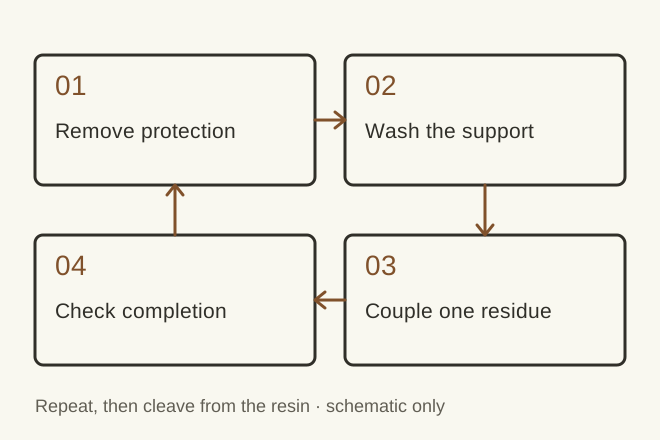
The described Fmoc (a temporary chemical protecting group) route assembles the protected fragment on a solid support. Coupling completion, side-chain protection and any acetylation step need their own records. A fragment may be shorter to assemble than its parent peptide, but its identity still includes the intended terminal groups.
Cleavage and deprotection release a crude mixture. The older account discusses scavengers, precipitation and recovery before purification. The technical table retains its example manufacturing sequence without turning it into a validated procedure.
What purification must separate
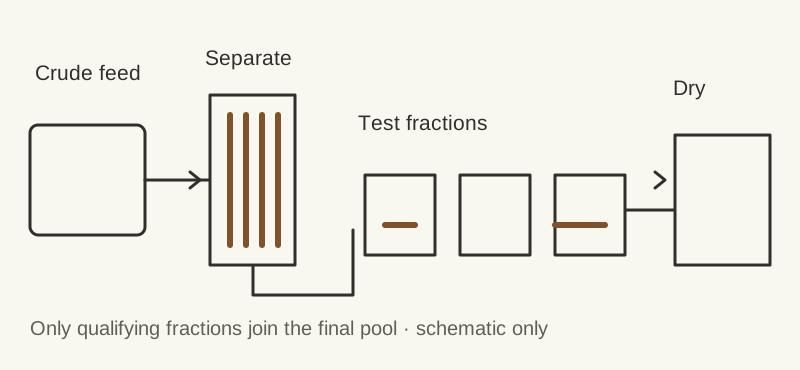
Preparative RP-HPLC (reversed-phase high-performance liquid chromatography, which separates mixture components) separates target material from deletion products, altered chains and other residues. Fraction tests matter because a collection window by itself cannot confirm purity or identity. The old column and loading parameters are examples.
Desalting and counterion exchange change the non-peptide material in the powder. Freeze-drying controls water and physical form. The recovered amount should therefore be assessed using peptide content as well as total mass.
What release testing can establish
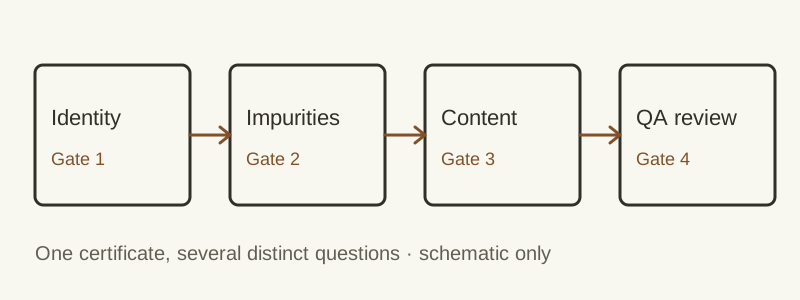
The older release panel separates identity, HPLC purity, related substances, content, water and microbiological testing. Mass should be compared with the exact fragment form being claimed. Results for a full-length peptide cannot satisfy that identity requirement.
The sample CoA and example quantity fields below illustrate document structure. They do not describe a verified batch, a clinical dose or the quality of any supplier’s product.
Where stability can be lost
The earlier stability programme compares long-term, accelerated and stress conditions. The purpose is to measure chemical and physical change in a defined container. A study schedule is not a shelf-life result.
Any solution-state stability claim needs its own formulation and analytical evidence. It cannot be derived from the powder’s example retest period.
What the batch record must show
A complete record links the fragment specification, raw-material lots, synthesis history, purified fractions, drying cycle and authorised release. The certificate needs actual results, methods and a traceable batch number. Deviations and changes should remain visible in the quality record.
FDA’s page current as of April 22, 2026 lists the thymosin beta-4 fragment LKKTETQ, described here as TB-500, among substances nominated but withdrawn. Withdrawal is not approval. This statement must not be broadened into a classification of full-length thymosin beta-4.
Technical tables & working schedules
TB-500 tables retain the earlier manufacturing examples. No TB-500 table here validates an operating procedure, release limit or supplier result. The TB-500 examples have no supporting batch raw data; use them to identify document fields, not to infer measured performance.
Product Identification and Molecular Characteristics8 rows
Inherited manufacturing example. TB-500 settings in this table are unvalidated examples, not supplier specifications or batch results. The TB-500 process and its measurement methods need separate qualification.
| Parameter | Specification |
|---|---|
| Chemical Name | N-Acetyl-L-leucyl-L-lysyl-L-lysyl-L-threonyl-L-glutamyl-L-threonyl-L-glutamine |
| Sequence | Ac-Leu-Lys-Lys-Thr-Glu-Thr-Gln |
| Molecular Formula | C41H76N12O14 |
| Molecular Weight | 963.13 g/mol (calculated as acetate salt) |
| CAS Number | 77591-33-4 (Thymosin Beta-4 Fragment) |
| Fragment Origin | Thymosin Beta-4 (Amino Acids 17-23) |
| Appearance | White to off-white lyophilized powder |
| Solubility | Soluble in water, PBS, and acidic aqueous solutions |
Solid-Phase Peptide Synthesis (SPPS) Methodology8 rows
Inherited manufacturing example. TB-500 settings in this table are unvalidated examples, not supplier specifications or batch results. The TB-500 process and its measurement methods need separate qualification.
| Synthesis Step | Reagents/Conditions | Duration | Quality Control |
|---|---|---|---|
| Resin Loading | Fmoc-Gln(Trt)-Wang resin, 0.5-0.8 mmol/g substitution | Pre-loaded resin | Resin substitution verification |
| Fmoc Deprotection | 20-25% piperidine in DMF | 5-10 minutes | UV monitoring at 301 nm (Fmoc-fulvene) |
| Amino Acid Activation | HBTU/HOBt or HATU/HOAt with DIEA | 1-2 minutes | Pre-activation time monitoring |
| Coupling Reaction | 3-5 equivalents Fmoc-amino acid, DMF solvent | 15-60 minutes | Kaiser test or chloranil test for completion |
| Washing | DMF (3x), DCM (3x), or equivalent solvent system | 2-5 minutes per wash | Visual inspection and filtration |
| Capping (if required) | Acetic anhydride/DIEA/DMF (5:6:89) | 5 minutes | Acetylation completion test |
| N-Terminal Acetylation | Acetic anhydride/DIEA following final Fmoc removal | 15-30 minutes | Mass spectrometry confirmation |
| Cleavage and Global Deprotection | TFA/water/TIS (95:2.5:2.5) or equivalent scavenger cocktail | 2-3 hours | Complete peptide release and side-chain deprotection |
Reversed-Phase HPLC Purification Strategy9 rows
Inherited manufacturing example. TB-500 settings in this table are unvalidated examples, not supplier specifications or batch results. The TB-500 process and its measurement methods need separate qualification.
| Purification Parameter | Specification | Rationale |
|---|---|---|
| Column Type | C18 reversed-phase silica, 10-20 μm particle size | Optimal retention and selectivity for hydrophobic peptides |
| Column Dimensions | 5-30 cm diameter × 20-50 cm length (scale-dependent) | Adequate loading capacity and resolution for target batch size |
| Mobile Phase A | Water + 0.1% TFA (v/v) | Protonates basic residues, improves peak shape |
| Mobile Phase B | Acetonitrile + 0.1% TFA (v/v) | Organic modifier for gradient elution |
| Gradient Profile | 15-45% B over 30-60 minutes (method-dependent) | Optimized separation of target from impurities |
| Flow Rate | 50-500 mL/min (scale-dependent) | Maintains resolution while maximizing throughput |
| Detection Wavelength | 214-220 nm | Peptide bond absorbance maximum |
| Column Loading | 5-25 g crude peptide per liter column volume | Balance between throughput and resolution |
| Fraction Collection Criteria | Peak fractions meeting >95% purity threshold | Ensures final product meets purity specifications |
Desalting and Lyophilization Operations4 rows
Inherited manufacturing example. TB-500 settings in this table are unvalidated examples, not supplier specifications or batch results. The TB-500 process and its measurement methods need separate qualification.
| Lyophilization Phase | Parameters | Duration | Critical Quality Attributes |
|---|---|---|---|
| Freezing | Cool from +5°C to -40°C at 1°C/min; hold at -40°C | 2-4 hours | Complete ice crystallization, uniform temperature |
| Primary Drying | -40°C to -10°C, vacuum 50-200 mTorr | 24-48 hours | Ice sublimation, residual moisture reduction to <5% |
| Secondary Drying | -10°C to +25°C, vacuum 20-100 mTorr | 8-24 hours | Removal of bound water to achieve <2% final moisture |
| Post-Drying | Nitrogen backfill to atmospheric pressure, sealing | 1-2 hours | Maintain low oxygen environment, prevent moisture uptake |
Analytical Testing and Quality Control11 rows
Inherited manufacturing example. TB-500 settings in this table are unvalidated examples, not supplier specifications or batch results. The TB-500 process and its measurement methods need separate qualification.
| Test | Method | Specification | Frequency |
|---|---|---|---|
| Identity (Sequence) | LC-MS/MS peptide mapping or amino acid analysis | Conforms to reference standard | Each batch |
| Identity (Molecular Weight) | ESI-MS or MALDI-TOF MS | 963.13 ± 1.0 Da (acetate salt) | Each batch |
| Purity (HPLC) | RP-HPLC, C18 column, UV 220 nm | ≥98.0% main peak area | Each batch |
| Related Substances | RP-HPLC with gradient method | Single impurity ≤1.0%; Total impurities ≤2.0% | Each batch |
| Water Content | Karl Fischer titration | ≤5.0% w/w | Each batch |
| Acetate Content | Ion chromatography or 1H-NMR | 3-8% w/w (for acetate salt form) | Each batch |
| TFA Content | 19F-NMR or ion chromatography | ≤0.5% w/w | Each batch |
| Peptide Content | Amino acid analysis with internal standard | 85-100% on anhydrous, salt-free basis | Each batch |
| Bacterial Endotoxins | LAL (Limulus Amebocyte Lysate) assay | ≤5 EU/mg peptide | Each batch |
| Bioburden | Plate count method (bacteria and fungi) | ≤100 CFU/g | Each batch |
| Sterility (if aseptic) | USP <71> Direct Inoculation Method | No growth in 14 days | Each batch (sterile products) |
Batch Manufacturing Specifications14 rows
Inherited manufacturing example. TB-500 settings in this table are unvalidated examples, not supplier specifications or batch results. The TB-500 process and its measurement methods need separate qualification.
| Attribute | Target Specification | Test Method |
|---|---|---|
| Appearance | White to off-white lyophilized powder | Visual inspection |
| Solubility | Clear, colorless solution at 5 mg/mL in water | Visual inspection after reconstitution |
| Identity (Retention Time) | RRT 0.98-1.02 relative to reference standard | RP-HPLC |
| Identity (Mass) | 963.13 ± 1.0 Da (acetate salt) | ESI-MS or MALDI-TOF MS |
| Purity by HPLC | ≥98.0% (main peak area percentage) | RP-HPLC, UV 220 nm |
| Single Largest Impurity | ≤1.0% | RP-HPLC |
| Total Impurities | ≤2.0% | RP-HPLC (sum of all peaks excluding main peak) |
| Water Content | ≤5.0% w/w | Karl Fischer titration |
| Acetate Content | 3.0-8.0% w/w | Ion chromatography or 1H-NMR |
| TFA Content | ≤0.5% w/w | 19F-NMR or ion chromatography |
| Peptide Content (net) | 85.0-100.0% (anhydrous, salt-free basis) | Amino acid analysis |
| Bacterial Endotoxins | ≤5.0 EU/mg | LAL Gel-Clot or Kinetic Chromogenic |
| Bioburden | ≤100 CFU/g (total aerobic count) | USP <61> <62> Plate Count |
| Heavy Metals | ≤10 ppm | ICP-MS or USP <231> colorimetric |
Stability Studies and Shelf-Life Determination8 rows
Inherited manufacturing example. TB-500 settings in this table are unvalidated examples, not supplier specifications or batch results. The TB-500 process and its measurement methods need separate qualification.
| Study Type | Storage Conditions | Duration | Testing Frequency |
|---|---|---|---|
| Long-Term Stability | -20°C ± 5°C (recommended storage) | 36 months minimum | 0, 3, 6, 9, 12, 18, 24, 36 months |
| Long-Term Stability (Alternative) | 2-8°C (refrigerated) | 24 months minimum | 0, 3, 6, 9, 12, 18, 24 months |
| Accelerated Stability | 25°C ± 2°C / 60% ± 5% RH | 6 months | 0, 3, 6 months |
| Intermediate Stability | 30°C ± 2°C / 65% ± 5% RH | 6 months (if needed) | 0, 3, 6 months |
| Stress Testing (Temperature) | 40°C, 50°C, 60°C | 1-4 weeks per condition | Initial and final timepoints |
| Stress Testing (pH) | pH 2, 4, 7, 10 at 25°C | 1-4 weeks | Initial and final timepoints |
| Stress Testing (Oxidation) | 0.3% H₂O₂ at 25°C | 24-48 hours | Initial and final timepoints |
| Photostability | ICH Option 2 light exposure | Until target exposure reached | Post-exposure analysis |
Storage and Handling Requirements5 rows
Inherited manufacturing example. TB-500 settings in this table are unvalidated examples, not supplier specifications or batch results. The TB-500 process and its measurement methods need separate qualification.
| Product Form | Storage Conditions | Stability Period | Special Handling |
|---|---|---|---|
| Lyophilized Powder (Unopened) | -20°C ± 5°C in sealed container | 24-36 months (per CoA) | Protect from light and moisture; store in original container |
| Lyophilized Powder (Unopened Alternative) | 2-8°C (refrigerated) | 12-24 months (per CoA) | Protect from light and moisture; do not freeze-thaw repeatedly |
| Lyophilized Powder (Short-term) | Room temperature (20-25°C) | Up to 30 days | Keep sealed; return to -20°C for long-term storage |
| Shipping (Ambient) | Insulated packaging with temperature monitoring | Transit time ≤5 days | Avoid direct sunlight; temperature loggers included |
| Shipping (Refrigerated) | 2-8°C with gel packs or dry ice | Per shipping validation | Qualified shipping containers; temperature monitoring |
Certificate of Analysis (CoA) Documentation12 rows
Illustrative record retained from the earlier edition. These TB-500 examples have no verified measurement dataset and cannot establish a batch result or supplier performance.
| CoA Section | Required Information | Example Data |
|---|---|---|
| Product Identification | Product name, catalog number, CAS number, molecular formula | TB-500 (Thymosin Beta-4 Fragment 17-23), Cat# TB500-5MG, CAS 77591-33-4 |
| Batch Information | Batch/lot number, manufacture date, retest/expiry date | Batch: TB500-2024-001, Mfg: 15-Jan-2024, Exp: 15-Jan-2027 |
| Physical Description | Appearance, net weight per vial, number of vials | White lyophilized powder, 5.2 mg net peptide per vial, 100 vials |
| Identity Tests | HPLC retention time, mass spectrometry molecular weight | RT: 18.5 min (conforms), MW: 963.1 Da (conforms) |
| Purity by HPLC | Main peak area percentage, chromatogram reference | 98.7% (Spec: ≥98.0%), Chromatogram: CHR-2024-001 |
| Related Substances | Individual impurity percentages, total impurities | Largest impurity: 0.6%, Total impurities: 1.3% (Spec: ≤2.0%) |
| Water Content | Percentage by Karl Fischer titration | 3.2% (Spec: ≤5.0%) |
| Peptide Content | Net peptide content by amino acid analysis | 92.5% (Spec: 85.0-100.0%, anhydrous, salt-free basis) |
| Endotoxins | LAL assay result in EU/mg | <0.5 EU/mg (Spec: ≤5.0 EU/mg) |
| Microbiological Quality | Total aerobic count, sterility (if applicable) | <10 CFU/g (Spec: ≤100 CFU/g); Sterile: Pass |
| Storage Conditions | Recommended storage temperature and conditions | Store at -20°C ± 5°C; protect from light and moisture |
| Approval | QC manager name, signature, date of approval | Approved by: J. Smith, QC Manager, Date: 22-Jan-2024 |
Source register
TB-500 source links are retained below. These references give context for TB-500 manufacturing; they do not validate the numerical examples. Duplicate TB-500 source links retain the citation record.
- [1]
- [2]
- [3]
- [4]
- [5]
- [6]
- [7]
- [8]
- [9]
- [10]
- [11]
- Bachem. "Solid Phase Peptide Synthesis (SPPS) Explained." https://www.bachem.com/articles/peptides/solid-phase-peptide-synthesis-explained/
- Behrendt R, White P, Offer J. "Automated solid-phase peptide synthesis to obtain therapeutic peptides." PMC. https://pmc.ncbi.nlm.nih.gov/articles/PMC4077397/
- Science Direct. "Sustainable Ultrasound-Assisted Solid-Phase peptide synthesis (SUS-SPPS): Less Waste, more efficiency." https://www.sciencedirect.com/science/article/pii/S1350417725000367
- PubMed. "Synthesis and characterization of the N-terminal acetylated 17-23 fragment of thymosin beta 4 identified in TB-500." https://pubmed.ncbi.nlm.nih.gov/22962027/
- PMC. "Recommended Best Practices for Lyophilization Validation 2021 Part II: Process Qualification and Continued Process Verification." https://pmc.ncbi.nlm.nih.gov/articles/PMC8575750/
- PMC. "Recommended Best Practices for Lyophilization Validation—2021 Part I: Process Design and Modeling." https://pmc.ncbi.nlm.nih.gov/articles/PMC8373746/
- International Conference on Harmonisation. "ICH Quality Guidelines." https://www.ich.org/page/quality-guidelines
- PubMed. "Doping control analysis of TB-500, a synthetic version of an active region of thymosin β₄, in equine urine and plasma by liquid chromatography-mass spectrometry." https://pubmed.ncbi.nlm.nih.gov/23084823/
- ICH. "Q1A(R2) Stability Testing Guidelines." https://database.ich.org/sites/default/files/Q1A(R2)%20Guideline.pdf
- International Conference on Harmonisation. "ICH Quality Guidelines - Stability Testing." https://www.ich.org/page/quality-guidelines
- PekCura Labs. "TB-500 - Certificates of Analysis." https://pekcuralabs.com/tb-500-certificates-of-analysis/