What has to be made
The earlier profile describes sermorelin acetate as a 29-amino-acid growth hormone-releasing hormone analogue with a terminal amide. Acetate is a counterion associated with the peptide, not an extra amino acid in the chain. The specification needs to state how that salt contributes to content.
The manufacturing profile concerns the material and its documentation. It does not establish a clinical indication, an approved research product or a treatment recommendation.
How the chain is assembled
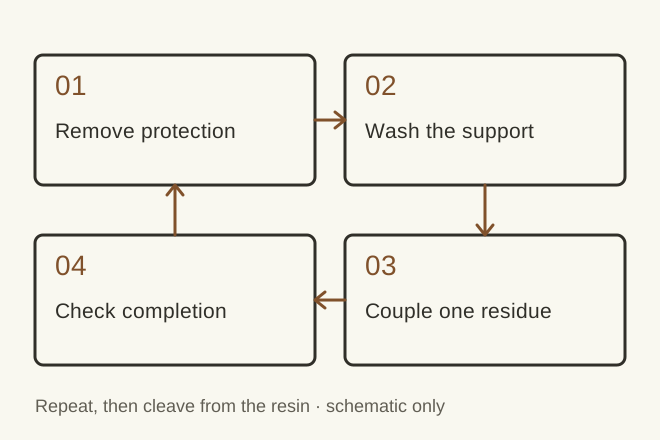
The described route uses Fmoc (a temporary chemical protecting group) solid-phase peptide synthesis with side-chain protection selected for the longer sequence. Incomplete coupling, aggregation on the support and unwanted side reactions can all affect crude quality. Monitoring should connect a difficult step with the impurity profile found later.
Final cleavage removes the peptide from the resin and releases acid-sensitive protection. Crude analysis guides what happens next. The earlier numerical coupling and scale examples are retained in the appendix, without presenting them as validated conditions.
What purification must separate
The older process uses preparative RP-HPLC (reversed-phase high-performance liquid chromatography, which separates mixture components) followed by polishing to improve separation from close impurities. Analytical fraction testing determines the pool. A single headline purity number does not describe what was excluded or left unresolved.
Counterion exchange establishes the intended acetate form, while solvent removal and freeze-drying control other parts of the final composition. Moisture and salt measurements help interpret actual peptide content rather than gross powder mass.
What release testing can establish
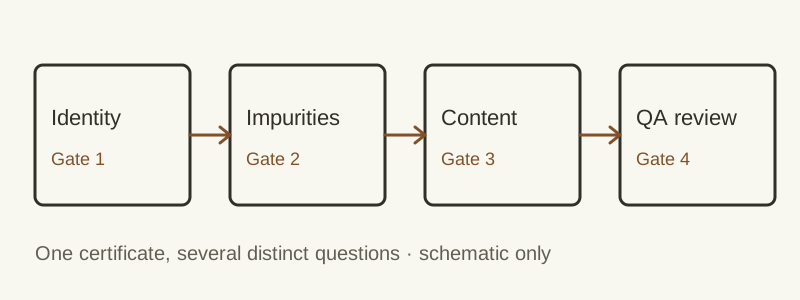
Mass spectrometry, composition and chromatographic comparison provide identity evidence. The earlier quality panel then separates purity, acetate content, water, residual solvents, endotoxin and sterility where applicable. A passing result in one test cannot stand in for the others.
Out-of-specification results need investigation before release. Repeating a test until a passing value appears does not explain the original result. The retained CoA specifications are examples; actual results and method references are needed for any batch.
Where stability can be lost
The earlier account discusses deamidation, oxidation and other related-peptide changes, alongside light and temperature studies. Container protection and environmental monitoring help interpret changes during storage. A validated stability method needs to detect the relevant degradation products.
Powder and solution data are separate. Storage durations in the inherited examples do not establish a general shelf life for an offered batch.
What the batch record must show
Raw-material specifications, equipment records, synthesis checks, purification pools and the release certificate should be traceable to the same batch. Scale-up and technology transfer need evaluation of mixing, separation and analytical performance. Change control and trend review support later adjustments.
The individual material needs its own identity and quality evidence. General GMP documentation is not itself a product approval or a guarantee of suitability for a particular programme.
Technical tables & working schedules
Sermorelin tables retain the earlier manufacturing examples. No Sermorelin table here validates an operating procedure, release limit or supplier result. The Sermorelin examples have no supporting batch raw data; use them to identify document fields, not to infer measured performance.
Sermorelin SPPS Critical Process Parameters8 rows
Inherited manufacturing example. Sermorelin settings in this table are unvalidated examples, not supplier specifications or batch results. The Sermorelin process and its measurement methods need separate qualification.
| Parameter | Specification | Monitoring Method |
|---|---|---|
| Resin Loading | 0.4-0.7 mmol/g | Fmoc quantification (UV 301 nm) |
| Coupling Efficiency | ≥99.5% per cycle | Kaiser/Chloranil test |
| Amino Acid Excess | 4-5 equivalents | Gravimetric verification |
| Coupling Time | 30-60 minutes | Timer validation |
| Deprotection Time | 3 + 10 minutes | UV monitoring (301 nm) |
| Cleavage Time | 2-4 hours | HPLC sampling |
| Crude Purity | 30-60% | Analytical HPLC |
| Crude Yield | 40-60% theoretical | Gravimetric analysis |
Purification Process Specifications4 rows
Inherited manufacturing example. Sermorelin settings in this table are unvalidated examples, not supplier specifications or batch results. The Sermorelin process and its measurement methods need separate qualification.
| Purification Stage | Column Type | Purity Target | Recovery |
|---|---|---|---|
| Preparative HPLC | C18, 21.2 x 250 mm, 10 μm | ≥95% | 40-60% |
| Semi-Preparative HPLC | C18, 10 x 250 mm, 5 μm | ≥98% | 70-85% |
| Desalting | Sephadex G-25 | Maintained | 85-95% |
| Lyophilization | N/A | Maintained | ≥95% |
Quality Control Testing Panel9 rows
Inherited manufacturing example. Sermorelin settings in this table are unvalidated examples, not supplier specifications or batch results. The Sermorelin process and its measurement methods need separate qualification.
| Test | Method | Specification |
|---|---|---|
| Identity | ESI-MS or MALDI-TOF MS | 3,357.96 ± 1.0 Da |
| Identity (secondary) | Amino Acid Analysis | Matches theoretical ± 10% |
| Purity | RP-HPLC (214 nm) | ≥98.0% |
| Related Substances | RP-HPLC | Single impurity ≤0.5%, Total ≤2.0% |
| Water Content | Karl Fischer | ≤5.0% |
| Acetate Content | Ion Chromatography | 1.5-3.5 molar eq |
| Residual TFA | IC or 19F-NMR | ≤0.1% |
| Bacterial Endotoxin | LAL | <5 EU/mg (research), <1 EU/mg (pharma) |
| Sterility | USP <71> | No growth (14 days) |
Manufacturing Batch Control Parameters8 rows
Inherited manufacturing example. Sermorelin settings in this table are unvalidated examples, not supplier specifications or batch results. The Sermorelin process and its measurement methods need separate qualification.
| Control Point | Parameter | Acceptance Criteria |
|---|---|---|
| Raw Material | Protected AA Purity | ≥98%, L-form ≥99% |
| Raw Material | Resin Loading | ±10% of stated value |
| Synthesis IPC | Coupling Efficiency | ≥99% per cycle |
| Synthesis IPC | Fmoc Deprotection | Complete (UV baseline return) |
| Purification IPC | Fraction Purity | ≥95% (1st stage), ≥98% (2nd stage) |
| Desalting IPC | Conductivity | <100 μS/cm |
| Lyophilization | Chamber Pressure | 50-150 mTorr (1°), 20-50 mTorr (2°) |
| Final Product | Moisture Content | ≤5.0% |
Stability Testing Conditions and Acceptance Criteria4 rows
Inherited manufacturing example. Sermorelin settings in this table are unvalidated examples, not supplier specifications or batch results. The Sermorelin process and its measurement methods need separate qualification.
| Study Type | Conditions | Duration | Acceptance Criteria |
|---|---|---|---|
| Long-term | 2-8°C | 24-36 months | Purity ≥95%, single impurity ≤1.0% |
| Accelerated | 25°C/60% RH | 6 months | Purity ≥95%, single impurity ≤1.0% |
| Stress | 40°C/75% RH | 6 months | Degradation pathway identification |
| Photostability | ICH Option 2 | As specified | Purity ≥90% vs dark control |
Storage Specifications and Conditions3 rows
Inherited manufacturing example. Sermorelin settings in this table are unvalidated examples, not supplier specifications or batch results. The Sermorelin process and its measurement methods need separate qualification.
| Product Form | Storage Temperature | Storage Duration | Special Considerations |
|---|---|---|---|
| Lyophilized (unopened) | -20°C to -30°C (long-term)2-8°C (routine) | 36 months24 months | Light protection, desiccation, inert atmosphere |
| Lyophilized (opened) | 2-8°C | Use promptly | Minimize exposure to air/moisture |
| During shipping | 2-8°C | Transit duration | Temperature monitoring required |
Representative Certificate of Analysis Specifications10 rows
Illustrative record retained from the earlier edition. These Sermorelin examples have no verified measurement dataset and cannot establish a batch result or supplier performance.
| Test Parameter | Method | Specification | Published evidence |
|---|---|---|---|
| Appearance | Visual | White to off-white powder | Not published |
| Identity (MS) | ESI-MS | 3,357.96 ± 1.0 Da | Not published |
| Identity (AAA) | HPLC-AAA | Conforms | Not published |
| Purity | RP-HPLC (214 nm) | ≥98.0% | Not published |
| Single Impurity | RP-HPLC | ≤0.5% | Not published |
| Total Impurities | RP-HPLC | ≤2.0% | Not published |
| Water Content | Karl Fischer | ≤5.0% | Not published |
| Acetate Content | Ion Chromatography | 1.5-3.5 molar eq | Not published |
| Residual TFA | 19F-NMR | ≤0.1% | Not published |
| Bacterial Endotoxin | LAL (Kinetic) | <1.0 EU/mg | Not published |
Source register
Sermorelin source links are retained below. These references give context for Sermorelin manufacturing; they do not validate the numerical examples. Duplicate Sermorelin source links retain the citation record.
- U.S. Food and Drug Administration. (2023). "Guidance for Industry: Q7 Good Manufacturing Practice Guidance for Active Pharmaceutical Ingredients." FDA CDER. Available at: https://www.fda.gov/regulatory-information/search-fda-guidance-documents/q7-good-manufacturing-practice-guidance-active-pharmaceutical-ingredients
- International Council for Harmonisation of Technical Requirements for Pharmaceuticals for Human Use. (2022). "ICH Q2(R2) Validation of Analytical Procedures - Scientific Guideline." ICH Official Website. Available at: https://www.ich.org/page/quality-guidelines
- International Council for Harmonisation. (2021). "ICH Q1A(R2): Stability Testing of New Drug Substances and Products." ICH Harmonised Guidelines. Available at: https://www.ich.org/page/quality-guidelines
- U.S. Pharmacopeial Convention. (2024). "General Chapter <1207> Sterile Product Packaging—Integrity Evaluation." United States Pharmacopeia. Available at: https://www.usp.org/
- European Medicines Agency. (2023). "Guideline on the Manufacture of the Finished Dosage Form." EMA/CHMP Guidelines. Available at: https://www.ema.europa.eu/en/human-regulatory/research-development/scientific-guidelines/manufacturing-importation
- U.S. Food and Drug Administration. (2022). "Analytical Procedures and Methods Validation for Drugs and Biologics - Guidance for Industry." FDA CDER/CBER. Available at: https://www.fda.gov/regulatory-information/search-fda-guidance-documents/analytical-procedures-and-methods-validation-drugs-and-biologics