What has to be made
The earlier profile gives Semax as the seven-residue sequence Met-Glu-His-Phe-Pro-Gly-Pro. It also discusses N-terminal acetylation. A modified terminal form must be named explicitly; it should not silently be treated as interchangeable with the unmodified sequence.
The tables retain the earlier example parameters and certificate format. Their masses and results are not verified specifications for every material called Semax. The intended form needs to be settled before comparing analytical results.
How the chain is assembled
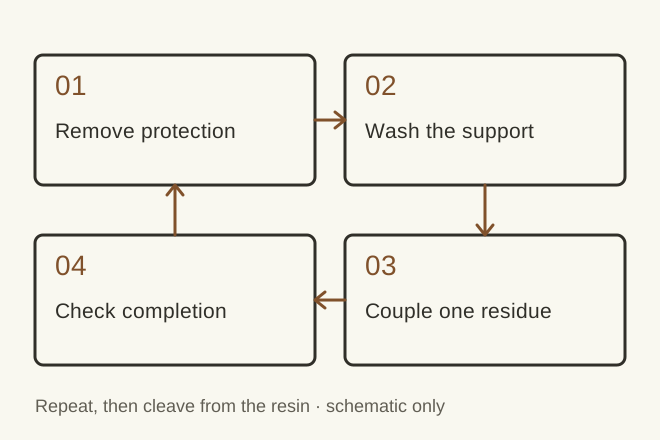
The described Fmoc (a temporary chemical protecting group) route assembles the chain on a solid support. The old account pays attention to protection and to oxidation around methionine during assembly, cleavage and recovery. Cleavage scavengers are included to reduce unwanted reactions.
Where acetylation is part of the intended target, the record needs evidence of its completion and a method for the unmodified species. It is a form-specific manufacturing choice, not a blanket claim about all Semax material.
What purification must separate
The purification method needs to distinguish the intended form from oxidation products, deletion sequences and other close impurities. Methionine sulfoxide is the oxidised variant highlighted in the older account. Analytical scouting and fraction tests establish useful collection boundaries.
The earlier route then removes solvents and counterions before freeze-drying. Formulation, filling, stoppering and crimping need documented controls. Light protection and minimising unwanted oxidation remain relevant beyond the first purification step.
What release testing can establish
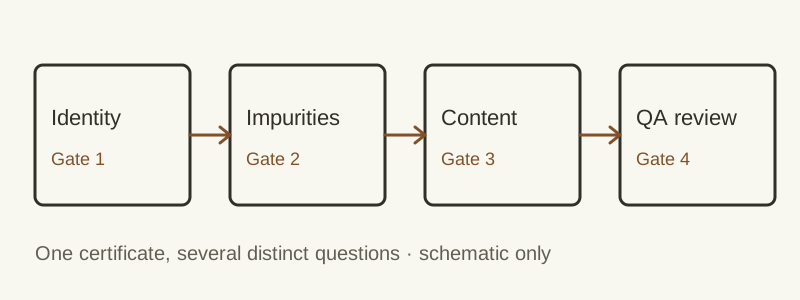
Identity testing needs agreement between mass, chromatographic comparison and the specified molecular form. Purity and quantitative content remain separate. Stability-indicating methods must show changes in the target and the relevant impurities rather than hide them under one peak.
The old panel also covers water, residual solvents, counterions and microbiological quality. Its sample certificate contains illustrative values. It is a model for reporting fields, not a real batch release certificate or evidence of a supplier’s performance.
Where stability can be lost
The older programme follows oxidation, light effects, temperature and formulation changes. Stress studies help identify degradation products; long-term studies support storage claims. An example schedule alone cannot establish shelf life.
Powder and solution stability require separate measurement. Storage alarms, shipping qualification, receiving checks and protective packaging belong in the actual material’s handling record.
What the batch record must show
The manufacturing record should explain the terminal form, key reagent lots, oxidation controls, in-process results, selected fractions and drying conditions. Yield reconciliation, deviations and authorised release connect that process history with the CoA. Electronic records need controlled access and a traceable audit trail.
FDA’s page current as of April 22, 2026 lists semax among substances nominated but withdrawn. That does not clear it for compounding or establish approval. A public Oath catalogue entry is a separate, limited fact.
Technical tables & working schedules
Semax tables retain the earlier manufacturing examples. No Semax table here validates an operating procedure, release limit or supplier result. The Semax examples have no supporting batch raw data; use them to identify document fields, not to infer measured performance.
Coupling Cycle Parameters6 rows
Inherited manufacturing example. Semax settings in this table are unvalidated examples, not supplier specifications or batch results. The Semax process and its measurement methods need separate qualification.
| Parameter | Specification | Monitoring Method |
|---|---|---|
| Amino Acid Excess | 3.0 equivalents ± 0.2 | Gravimetric verification |
| Activation Time | 2-5 minutes | Process timing validation |
| Coupling Duration | 45-60 minutes | Automated synthesis monitoring |
| Temperature Control | 20-25°C ± 2°C | Continuous temperature monitoring |
| DMF Quality | Peptide synthesis grade, <0.005% water | Karl Fischer analysis per batch |
| Coupling Efficiency | >99.5% by Kaiser test | Colorimetric ninhydrin assay |
Cleavage Process Parameters6 rows
Inherited manufacturing example. Semax settings in this table are unvalidated examples, not supplier specifications or batch results. The Semax process and its measurement methods need separate qualification.
| Parameter | Specification | Critical Quality Impact |
|---|---|---|
| Cleavage Duration | 2-3 hours | Complete deprotection without methionine oxidation |
| Temperature | 20-25°C ± 2°C | Minimize oxidation and maintain scavenger activity |
| Cocktail Volume | 10-15 mL/g resin | Adequate scavenger capacity and mixing |
| Resin Separation | Complete filtration within 15 minutes | Minimize peptide exposure to acidic conditions |
| TFA Removal | Rotary evaporation at <30°C | Prevent thermal degradation during concentration |
| Oxygen Exclusion | Nitrogen blanket during cleavage | Prevent methionine oxidation |
Gradient Optimization and Method Parameters6 rows
Inherited manufacturing example. Semax settings in this table are unvalidated examples, not supplier specifications or batch results. The Semax process and its measurement methods need separate qualification.
| Time (min) | %B | Flow Rate (mL/min) | Purpose |
|---|---|---|---|
| 0-5 | 10 | 30 | Initial equilibration and sample loading |
| 5-8 | 10-15 | 30 | Wash highly polar impurities and salts |
| 8-35 | 15-35 | 30 | Shallow gradient for critical separation of Semax from impurities |
| 35-40 | 35-95 | 30 | Steep gradient for hydrophobic impurities |
| 40-45 | 95 | 30 | Column wash |
| 45-55 | 95-10 | 30 | Re-equilibration |
Vial Filling Operations6 rows
Inherited manufacturing example. Semax settings in this table are unvalidated examples, not supplier specifications or batch results. The Semax process and its measurement methods need separate qualification.
| Parameter | Specification | Quality Assurance |
|---|---|---|
| Fill Volume Accuracy | ±5% of target volume | Gravimetric verification every 10 vials |
| Vial Type | Type I borosilicate glass, 3-5 mL amber | Certificate of analysis from vendor |
| Stopper Type | Fluoropolymer-coated butyl rubber, 13 mm | Extractables/leachables testing |
| Seal Integrity | Vacuum hold test: <100 μm Hg loss in 60 seconds | 100% inspection post-lyophilization |
| Particulate Matter | Zero visible particles per USP <790> | Visual inspection under controlled lighting |
| Light Protection | Amber glass or opaque secondary packaging | UV transmission testing |
Content and Potency Assays4 rows
Inherited manufacturing example. Semax settings in this table are unvalidated examples, not supplier specifications or batch results. The Semax process and its measurement methods need separate qualification.
| Method | Principle | Specification |
|---|---|---|
| Quantitative HPLC | External standard calibration at 214 nm | 90-110% of label claim |
| UV Spectroscopy | Absorbance at 257 nm using Phe extinction coefficient | Supporting data for HPLC results |
| Amino Acid Analysis | Quantitation of hydrolyzed amino acids vs. standards | Confirmatory method, 85-115% agreement |
| Peptide Content (corrected) | HPLC assay corrected for water and TFA content | Report as peptide content on anhydrous, TFA-free basis |
In-Process Control Strategy8 rows
Inherited manufacturing example. Semax settings in this table are unvalidated examples, not supplier specifications or batch results. The Semax process and its measurement methods need separate qualification.
| Manufacturing Stage | In-Process Control | Frequency | Action on OOS Result |
|---|---|---|---|
| Solid-Phase Synthesis | Kaiser test after coupling | Each of 7 cycles | Repeat coupling until negative test |
| Solid-Phase Synthesis | UV monitoring at 301 nm | Each deprotection cycle | Extend deprotection time |
| N-Terminal Acetylation | Kaiser test (must remain negative) | After acetylation | Repeat acetylation treatment |
| Cleavage | Reaction time and temperature | Continuous monitoring | Extend within validated range |
| Crude Recovery | MS confirmation of MW 813.9 Da | Each batch | Investigate if incorrect MW detected |
| Purification | Fraction purity by analytical HPLC | Each fraction or pool | Exclude from pool or re-purify |
| Purification | Met-sulfoxide monitoring | Each batch | Must be <0.5%; reject if exceeded |
| Lyophilization | Pressure/temperature monitoring | Continuous recording | Investigate cycle failure |
Stability-Indicating Test Methods8 rows
Inherited manufacturing example. Semax settings in this table are unvalidated examples, not supplier specifications or batch results. The Semax process and its measurement methods need separate qualification.
| Test | Method | Acceptance Criteria at Release | Shelf-Life Specification |
|---|---|---|---|
| Appearance | Visual inspection | White to off-white powder | No significant color change |
| Identification (MS) | ESI-MS | MW 813.9 ± 0.3 Da | MW 813.9 ± 0.3 Da |
| Purity (HPLC) | RP-HPLC at 214 nm | ≥98.0% | ≥95.0% |
| Assay (Content) | Quantitative HPLC | 95.0-105.0% | 90.0-110.0% |
| Met-Sulfoxide | RP-HPLC peak tracking | ≤0.5% | ≤2.0% |
| Deacetylated Peptide | RP-HPLC peak tracking | ≤0.5% | ≤1.5% |
| Water Content | Karl Fischer | ≤3.0% | ≤5.0% |
| Aggregates | SEC-HPLC | ≤0.5% | ≤2.0% |
Environmental Monitoring Programs4 rows
Inherited manufacturing example. Semax settings in this table are unvalidated examples, not supplier specifications or batch results. The Semax process and its measurement methods need separate qualification.
| Storage Area | Monitoring Parameters | Frequency | Action Limits |
|---|---|---|---|
| Freezer (-20°C) | Temperature | Continuous recording, 15-min intervals | Alert: -23°C or -17°C; Action: -25°C or -15°C |
| Refrigerator (2-8°C) | Temperature | Continuous recording, 15-min intervals | Alert: <1°C or >9°C; Action: <0°C or >10°C |
| All storage areas | Light exposure | Annual verification | No direct sunlight, <200 lux ambient light |
| Nitrogen-filled containers | Headspace oxygen content | Quarterly sampling | Alert: >3% O2; Action: >5% O2 |
Analytical Test Results Table14 rows
Illustrative record retained from the earlier edition. These Semax examples have no verified measurement dataset and cannot establish a batch result or supplier performance. The terminal modification and theoretical mass must agree; this example does not establish which Semax form was tested.
| Test | Method | Specification | Result |
|---|---|---|---|
| Appearance | Visual | White to off-white powder | White lyophilized powder |
| Identity (HPLC) | RP-HPLC | RT matches standard ±2% | Conforms (RT: 19.8 min) |
| Identity (MS) | ESI-MS | MW: 813.9 ±0.3 Da | 813.9 Da (M+H = 814.9) |
| Amino Acid Composition | AAA after hydrolysis | Conforms to expected ratio | Conforms |
| Purity (HPLC) | RP-HPLC at 214 nm | ≥98.0% | 98.7% |
| Assay (Content) | Quantitative HPLC | 90.0-110.0% | 97.3% |
| N-Acetylation | MS and HPLC | Complete; no free N-terminal | Confirmed acetylated |
| Met-Sulfoxide | RP-HPLC | ≤0.5% | 0.2% |
| Deacetylated Peptide | RP-HPLC | ≤0.5% | 0.1% |
| Water Content | Karl Fischer | ≤3.0% | 1.8% |
| Acetonitrile | GC | ≤410 ppm | <50 ppm |
| TFA | Ion chromatography | ≤0.5% | 0.12% |
| Heavy Metals | ICP-MS | ≤10 ppm | <2 ppm |
| Bacterial Endotoxins | LAL | ≤10 EU/mg | <1 EU/mg |
Source register
Semax source links are retained below. These references give context for Semax manufacturing; they do not validate the numerical examples. Duplicate Semax source links retain the citation record.
- cGMP regulations for peptide therapeutics
- ICH Q7 guidelines for API manufacturing
- FDA guidance on lyophilization of parenteral products
- USP <1225> validation of compendial procedures
- FDA cGMP requirements
- U.S. Food and Drug Administration. (2023). Current Good Manufacturing Practice (CGMP) Regulations for Drugs. 21 CFR Parts 210 and 211. Available at: https://www.fda.gov/drugs/pharmaceutical-quality-resources/current-good-manufacturing-practice-cgmp-regulations
- International Council for Harmonisation (ICH). (2023). ICH Q7: Good Manufacturing Practice Guide for Active Pharmaceutical Ingredients. Available at: https://www.ich.org/page/quality-guidelines
- U.S. Food and Drug Administration. (2022). Guidance for Industry: Lyophilization of Parenteral Products. Center for Drug Evaluation and Research. Available at: https://www.fda.gov/regulatory-information/search-fda-guidance-documents/guidance-industry-lyophilization-parenteral-products
- United States Pharmacopeia. (2024). USP <1225> Validation of Compendial Procedures. Available at: https://www.usp.org/validation
- International Council for Harmonisation (ICH). (2023). ICH Q1A(R2): Stability Testing of New Drug Substances and Products. Available at: https://www.ich.org/page/quality-guidelines
- International Council for Harmonisation (ICH). (2023). ICH Q1B: Photostability Testing of New Drug Substances and Products. Available at: https://www.ich.org/page/quality-guidelines
- International Council for Harmonisation (ICH). (2023). ICH Q3C(R6): Impurities: Guideline for Residual Solvents. Available at: https://www.ich.org/page/quality-guidelines
- United States Pharmacopeia. (2024). USP <788> Particulate Matter in Injections and USP <790> Visible Particulates in Injections. Available at: https://www.usp.org
- U.S. Food and Drug Administration. (2023). Facts about the Current Good Manufacturing Practices (CGMPs). Available at: https://www.fda.gov/drugs/pharmaceutical-quality-resources/facts-about-current-good-manufacturing-practices-cgmps