What has to be made
The earlier profile gives Selank as Thr-Lys-Pro-Arg-Pro-Gly-Pro, a seven-residue peptide. Its research history does not establish a clinical outcome. Manufacturing identity needs the complete sequence and an explicit statement of the terminal form.
The older resin discussion refers to amide-forming supports without consistently separating terminal-form specifications. That ambiguity is not resolved here by choosing a form. The inherited tables remain examples requiring confirmation against the actual product specification.
How the chain is assembled
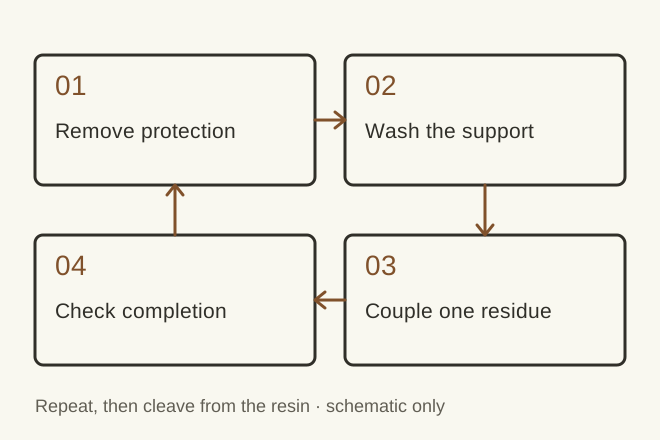
The described route uses Fmoc (a temporary chemical protecting group) solid-phase peptide synthesis, with protected side chains and coupling checks as the chain is assembled. Proline-rich segments call for appropriate monitoring of reaction completion; the process record needs evidence rather than an assumption based on sequence length.
Cleavage and deprotection produce a crude mixture for analysis. The earlier process discussion covers activation reagents, resin behaviour and crude characterisation. Those are linked variables in development, not a transferable production recipe.
What purification must separate
RP-HPLC (reversed-phase high-performance liquid chromatography, which separates mixture components) separates the intended chain from deletion sequences and other related material. Analytical review determines which fractions can be combined. The old preparative settings and recovery figures are retained as unverified examples.
Counterion exchange is particularly relevant to interpreting weighed material with basic side chains. Water and associated salts add mass without becoming peptide. Freeze-drying and final isolation therefore need both physical checks and a measured content result.
What release testing can establish
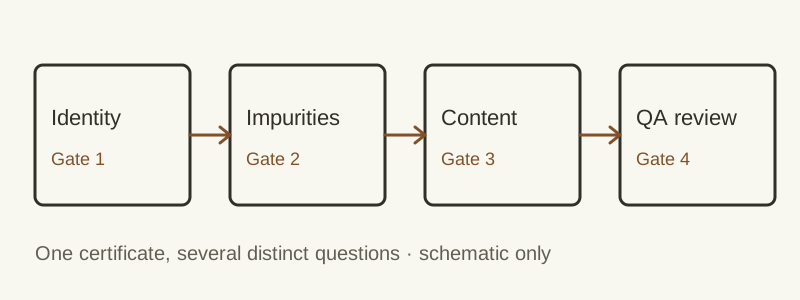
The earlier identity panel combines mass, composition and chromatographic evidence. Purity measures the detected impurity profile; content measures peptide relative to the whole sample. Those results should appear separately on a certificate.
Impurity profiling, residual-solvent analysis, water and microbiological methods complete different parts of release testing. Every claimed result needs a method reference, qualified standard where relevant, and the actual batch identifier.
Where stability can be lost
The earlier stability account considers hydrolysis, oxidation, aggregation and possible cyclisation. Those are proposed pathways to investigate with methods that can distinguish target from changed material. Light and temperature stress are part of study design.
Storage and shipping records should refer to data for the actual powder and container. Powder stability is not evidence of the stability of every laboratory solution.
What the batch record must show
The batch record connects material qualification, synthesis, purification, drying and quality review. Digital certificates need traceable source data and controlled signatures. Process design, qualification and continued monitoring remain separate stages during scale-up and technology transfer.
FDA’s page current as of April 22, 2026 lists selank among substances nominated but withdrawn. Withdrawal does not mean clearance or approval. Its public Oath listing establishes a catalogue entry, not drug status or suitability of a particular lot.
Technical tables & working schedules
Selank tables retain the earlier manufacturing examples. No Selank table here validates an operating procedure, release limit or supplier result. The Selank examples have no supporting batch raw data; use them to identify document fields, not to infer measured performance.
SPPS Process Parameters for Selank Manufacturing9 rows
Inherited manufacturing example. Selank settings in this table are unvalidated examples, not supplier specifications or batch results. The Selank process and its measurement methods need separate qualification. The inherited support discussion does not resolve the terminal form; verify it against the actual sequence specification.
| Process Step | Reagent System | Reaction Time | Temperature | Acceptance Criteria |
|---|---|---|---|---|
| Resin Swelling | DMF or DCM | 30-60 minutes | 20-25°C | Complete resin bed expansion |
| Fmoc Deprotection (1st treatment) | 20% piperidine/DMF | 3-5 minutes | 20-25°C | Initial UV₃₀₁ signal increase |
| Fmoc Deprotection (2nd treatment) | 20% piperidine/DMF (fresh) | 10-15 minutes | 20-25°C | UV₃₀₁ return to baseline |
| Standard Amino Acid Coupling | HATU/DIEA/DMF (3-5 eq) | 1-2 hours | 20-25°C | >99.5% coupling yield (Kaiser test) |
| Proline Coupling | HATU/DIEA/DMF (5-8 eq) | 2-4 hours or double coupling | 20-25°C | >99.5% coupling yield (chloranil test) |
| Capping (if required) | Ac₂O/DIEA/DMF | 5-10 minutes | 20-25°C | Negative Kaiser/chloranil test |
| Final Cleavage | TFA:H₂O:TIS:EDT (92.5:2.5:2.5:2.5) | 2-4 hours | 20-25°C | Complete peptide release from resin |
| Crude Precipitation | Cold diethyl ether (10-15 volumes) | N/A | -20 to 4°C | White to off-white precipitate formation |
| Ether Washing | Cold diethyl ether (3-5 washes) | N/A | 0-4°C | Neutral pH wash solution |
Purification Process Parameters and Recovery Yields6 rows
Inherited manufacturing example. Selank settings in this table are unvalidated examples, not supplier specifications or batch results. The Selank process and its measurement methods need separate qualification.
| Purification Stage | Method | Published evidence | Recovery Yield |
|---|---|---|---|
| Initial Crude Dissolution | Aqueous solvent with TFA | Not published | 95-99% |
| Primary RP-HPLC Purification | C18 preparative column | Not published | 60-75% |
| Secondary Polish (if required) | RP-HPLC or IEX | Not published | 85-95% |
| Desalting/Counter-ion Exchange | Size exclusion (Sephadex G-25) | Not published | 90-95% |
| Lyophilization | Freeze-drying cycle | Not published | 95-99% |
| Overall Process Yield | From crude to final product | Not published | Not published |
Analytical Testing Panel and Acceptance Criteria16 rows
Inherited manufacturing example. Selank settings in this table are unvalidated examples, not supplier specifications or batch results. The Selank process and its measurement methods need separate qualification.
| Test Parameter | Test Methodology | Acceptance Specification | Test Frequency |
|---|---|---|---|
| Appearance | Visual inspection | White to off-white lyophilized powder | Each batch |
| Identity (primary) | HRMS (ESI or MALDI-TOF) | [M+H]⁺ = 752.87 ± 0.2 m/z | Each batch |
| Identity (secondary) | RP-HPLC retention time | Matches reference standard ± 2% | Each batch |
| Identity (tertiary) | Amino acid analysis (qualitative) | Amino acid ratios consistent with structure | Reference standard only |
| Purity by HPLC | RP-HPLC (214 nm, area normalization) | ≥98.0% main peak | Each batch |
| Single Impurity | RP-HPLC (214 nm) | ≤1.0% any individual impurity | Each batch |
| Total Impurities | RP-HPLC (214 nm) | ≤2.0% sum of all impurities | Each batch |
| Peptide Content | Quantitative amino acid analysis | 75-95% (as is basis) | Each batch |
| Water Content | Karl Fischer titration | ≤5.0% | Each batch |
| TFA Content (if applicable) | Ion chromatography or ¹⁹F-NMR | Not published | Each batch |
| Acetate Content (if acetate salt) | Ion chromatography | 5-15% (theoretical ~8% for monoacetate) | Each batch |
| pH (1% solution in water) | pH meter | 4.0-6.0 (acetate salt) or 3.5-5.5 (free base) | Each batch |
| Bacterial Endotoxin | LAL (Limulus Amebocyte Lysate) assay | ≤10 EU/mg | Each batch |
| Bioburden (if not sterilized) | Plate count (USP <61>, <62>) | ≤1000 CFU/g | Each batch |
| Sterility (if sterile product) | USP <71> or Ph.Eur. 2.6.1 | No growth observed | Each batch (sterile products) |
| Heavy Metals | ICP-MS (inductively coupled plasma mass spec) | ≤10 ppm total | Each batch or per qualification |
Critical Quality Attributes and Process Parameters10 rows
Inherited manufacturing example. Selank settings in this table are unvalidated examples, not supplier specifications or batch results. The Selank process and its measurement methods need separate qualification.
| Attribute/Parameter | Target Value/Range | Monitoring Method | Impact if Out of Range |
|---|---|---|---|
| Resin Loading Capacity | 0.4-0.6 mmol/g | Fmoc quantification (UV) | Affects synthesis scale and coupling efficiency |
| Coupling Efficiency | >99.5% each step | Kaiser or chloranil test | Generates deletion sequence impurities |
| Deprotection Completion | UV₃₀₁ baseline return | UV spectroscopy at 301 nm | Chain termination, deletion sequences |
| Crude Peptide Purity | ≥40% by HPLC | Analytical RP-HPLC | Reduced purification yield, extended purification |
| Purification Recovery | 60-75% (primary purification) | Weight/UV quantification | Economic impact, batch yield reduction |
| Final Product Purity | ≥98.0% by HPLC | Validated analytical RP-HPLC | Batch rejection if below specification |
| Peptide Content | 75-95% (as is basis) | Quantitative amino acid analysis | Dosing accuracy, formulation calculations |
| Residual Moisture | ≤5.0% | Karl Fischer titration | Reduced stability, increased degradation rate |
| Bacterial Endotoxin | ≤10 EU/mg | LAL chromogenic assay | Pyrogenic reactions in biological systems |
| Manufacturing Environment | ISO Class 7 or 8 | Particle counting, bioburden | Contamination risk, GMP compliance |
Stability Testing Conditions and Specifications9 rows
Inherited manufacturing example. Selank settings in this table are unvalidated examples, not supplier specifications or batch results. The Selank process and its measurement methods need separate qualification.
| Study Type | Storage Condition | Study Duration | Testing Schedule | Primary Acceptance Criteria |
|---|---|---|---|---|
| Long-term (frozen) | -20°C ± 5°C | 36 months | 0, 3, 6, 9, 12, 18, 24, 36 months | Purity ≥98.0%, content 90-110% of initial |
| Long-term (refrigerated) | 5°C ± 3°C | 24 months | 0, 3, 6, 9, 12, 18, 24 months | Purity ≥98.0%, content 90-110% of initial |
| Intermediate | 30°C ± 2°C / 65% RH ± 5% | 12 months | 0, 3, 6, 9, 12 months | Purity ≥97.0%, content 90-110% of initial |
| Accelerated | 25°C ± 2°C / 60% RH ± 5% | 6 months | 0, 1, 2, 3, 6 months | Purity ≥95.0%, content 90-110% of initial |
| Stressed (thermal) | 40°C ± 2°C / 75% RH ± 5% | 3 months | 0, 1, 2, 3 months | Characterize degradation, no specification |
| Stressed (pH) | pH 2, pH 10 at 40°C | 7 days | 0, 1, 3, 7 days | Characterize degradation, no specification |
| Stressed (oxidative) | 3% H₂O₂ at 25°C | 24 hours | 0, 6, 12, 24 hours | Characterize degradation, no specification |
| Photostability | 1.2M lux·hr visible + 200 W·hr/m² UV | Single exposure | Post-exposure only | Document sensitivity, justify protection |
| Freeze-thaw | -80°C to +25°C (5 cycles) | 5 cycles over 1-2 weeks | After each cycle and final | Purity ≥98.0%, no visible aggregates |
Storage and Handling Specifications for Selank4 rows
Inherited manufacturing example. Selank settings in this table are unvalidated examples, not supplier specifications or batch results. The Selank process and its measurement methods need separate qualification.
| Product State | Storage Temperature | Additional Requirements | Recommended Shelf Life |
|---|---|---|---|
| Lyophilized powder (unopened) | -20°C ± 5°C | Sealed container, protected from light and moisture | 24-36 months (per stability data) |
| Lyophilized powder (unopened) | 2-8°C | Sealed container, protected from light and moisture | 12-18 months (verify with stability data) |
| During transportation | -20°C or 2-8°C (per product spec) | Validated shipping container, temperature monitoring | Not published |
| Room temperature exposure (unopened vial) | 20-25°C | For brief periods during handling only | Up to 2 hours cumulative exposure acceptable |
Certificate of Analysis Required Components10 rows
Illustrative record retained from the earlier edition. These Selank examples have no verified measurement dataset and cannot establish a batch result or supplier performance.
| CoA Section | Information Elements | Purpose |
|---|---|---|
| Product Identification | Product name, chemical name, CAS#, molecular formula, molecular weight, sequence | Unambiguous product identification |
| Batch Information | Lot/batch number, manufacturing date, expiration date, quantity (gross and net) | Batch traceability and inventory management |
| Manufacturer Information | Company name, address, phone, email, website, regulatory registrations | Manufacturer identification and contact |
| Storage Conditions | Temperature requirement, light protection, moisture protection, shelf life | Proper handling and storage guidance |
| Test Results Table | Test parameter, method reference, specification, actual result, conformance status | Quality compliance documentation |
| Quality Assurance Approval | QA signature (digital or wet), name, title, approval date | Batch release authorization |
| Regulatory Statements | Intended use, regulatory disclaimers, controlled substance info (if applicable) | Legal compliance and use restrictions |
| Document Control | CoA number, issue date, revision status, page numbering | Version control and document management |
| Testing Methodology Summary (optional) | Brief method descriptions or references to validated SOPs | Analytical transparency |
| Supplemental Data (optional) | HPLC chromatogram, mass spectrum, amino acid analysis data | Enhanced verification and technical review |
Source register
Selank source links are retained below. These references give context for Selank manufacturing; they do not validate the numerical examples. Duplicate Selank source links retain the citation record.
- 1
- 2
- 3
- 4
- 5
- 6
- 7
- 8
- 9
- 10
- 11
- 12
- 13
- 14
- Coin I, Beyermann M, Bienert M. "Solid-phase peptide synthesis: from standard procedures to the synthesis of difficult sequences." Nature Protocols. 2007;2(12):3247-3256. Available at: https://www.ncbi.nlm.nih.gov/pmc/articles/PMC6315689/
- Amblard M, Fehrentz JA, Martinez J, Subra G. "Methods and protocols of modern solid phase peptide synthesis." Molecular Biotechnology. 2006;33(3):239-254. Available at: https://www.sciencedirect.com/science/article/pii/S0040402013012345
- Albericio F. "Developments in peptide and amide synthesis." Current Opinion in Chemical Biology. 2004;8(3):211-221. Available at: https://pubs.acs.org/doi/10.1021/cr040410z
- Fekete S, Guillarme D, Dong MW. "Chromatographic and mass spectrometric strategies for peptide bioanalysis and purification." Chromatography Today. 2019. Available at: https://www.chromatographytoday.com/news/hplc-uhplc/31/breaking-news/peptide-purification-strategies-for-pharmaceutical-manufacturing/58923
- Patel SM, Doen T, Pikal MJ. "Determination of end point of primary drying in freeze-drying process control." American Pharmaceutical Review. 2010. Available at: https://www.americanpharmaceuticalreview.com/Featured-Articles/188841-Lyophilization-Process-Development-and-Optimization/
- International Council for Harmonisation (ICH). "ICH Q2(R1): Validation of Analytical Procedures: Text and Methodology." 2005. Available at: https://www.ich.org/page/quality-guidelines
- United States Pharmacopeia (USP). "General Chapter <1065>: Ion Chromatography." Available at: https://www.usp.org/harmonization-standards/pdg
- U.S. Food and Drug Administration. "Current Good Manufacturing Practice (CGMP) Regulations." 21 CFR Parts 210, 211. Available at: https://www.fda.gov/drugs/pharmaceutical-quality-resources/current-good-manufacturing-practice-cgmp-regulations
- U.S. Food and Drug Administration. "Investigating Out-of-Specification (OOS) Test Results for Pharmaceutical Production." 2006. Available at: https://www.fda.gov/regulatory-information/search-fda-guidance-documents/investigating-out-specification-oos-test-results-pharmaceuticals
- International Council for Harmonisation (ICH). "Q1A(R2): Stability Testing of New Drug Substances and Products." 2003. Available at: https://database.ich.org/sites/default/files/Q1A%28R2%29%20Guideline.pdf
- United States Pharmacopeia (USP). "General Chapter <1079>: Good Storage and Distribution Practices for Drug Products." Available at: https://www.usp.org/harmonization-standards/pdg/general-chapters/storage-distribution
- U.S. Food and Drug Administration. "Guidance for Industry: Part 11, Electronic Records; Electronic Signatures — Scope and Application." 2003. Available at: https://www.fda.gov/media/71001/download
- U.S. Food and Drug Administration. "Process Validation: General Principles and Practices." 2011. Available at: https://www.fda.gov/regulatory-information/search-fda-guidance-documents/process-validation-general-principles-and-practices
- U.S. Food and Drug Administration. "Guide to Inspections Validation of Cleaning Processes (7/93)." Available at: https://www.fda.gov/inspections-compliance-enforcement-and-criminal-investigations/inspection-guides/guide-inspections-validation-cleaning-processes-7937