What has to be made
The older profile describes PT-141, also called bremelanotide, as a synthetic melanocortin peptide. The manufacturing questions concern the exact terminal form, internal ring and D-phenylalanine configuration. A short catalogue name cannot settle all three.
The earlier resin discussion and release tables are retained as examples. They should not be treated as a specification for every form sold under this name. Research material and an authorised finished drug product require separate evidence.
How the chain is assembled
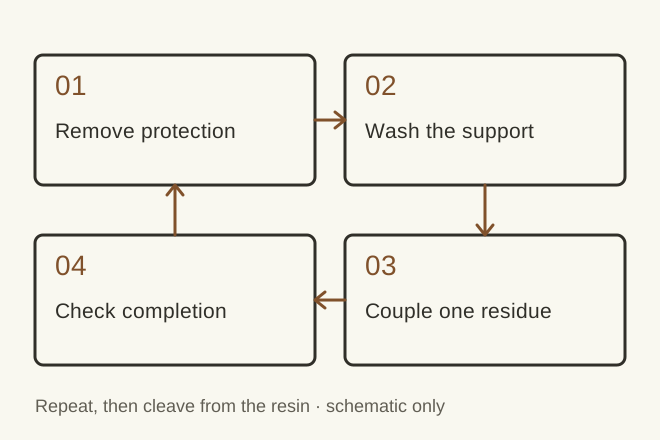
The described route builds a protected linear chain with Fmoc (a temporary chemical protecting group) chemistry, then applies N-terminal acetylation and lactam closure between aspartic acid and lysine side chains. Selective protection controls which groups can react.
Incomplete closure leaves linear material that needs to be measured and separated. Cleavage removes the chain from its support and removes other protecting groups. Crude recovery and impurity assessment provide a checkpoint before preparative purification.
What purification must separate
The old RP-HPLC (reversed-phase high-performance liquid chromatography, which separates mixture components) route is designed around separation of the cyclic target from linear, incomplete and modified products. Preparative fraction collection should be tied to analytical results rather than a fixed retention-time window alone.
Desalting addresses counterions that can contribute appreciably to gross mass. Freeze-drying addresses water and physical form. Neither operation substitutes for resolving the correct terminal structure or ring closure.
What release testing can establish
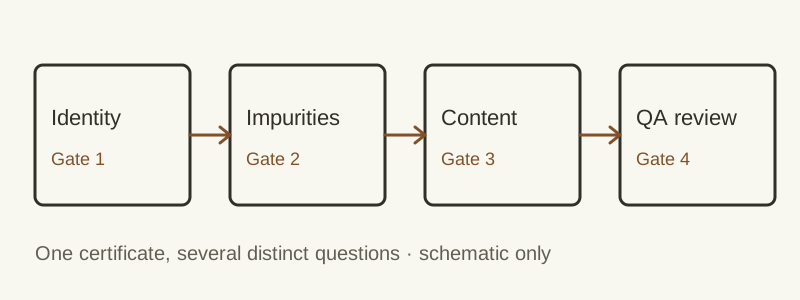
The earlier panel combines identity, HPLC purity, amino acid composition, content and stereochemical purity. Each asks a different question. A qualified reference standard connects the analytical result to the intended PT-141 form.
Residual-solvent analysis, water, endotoxin and other microbial tests require their own methods. The numerical specifications and sample certificate remain inherited examples. They are not an observed release record or a basis for dosing.
Where stability can be lost
The old stability sections discuss chemical degradation, oxidation and aggregation, with formulation development intended to reduce those changes. Container compatibility and extractables studies examine what may move between the material and its packaging.
Powder storage and a solution’s stability require separate data. The retained example study programme describes measurements to consider, not a universal storage guarantee.
What the batch record must show
Scale-up affects mixing, heat transfer, reagent addition and solvent handling. Troubleshooting incomplete cyclisation or poor separation needs data from the affected stage. Change control, deviations, method validation and supplier qualification make those decisions traceable.
The molecular form needs to be established before applying a specification. A manufacturing reference is not an endorsement of any drug brand or an extension of a finished product’s approval to research material.
Technical tables & working schedules
PT-141 tables retain the earlier manufacturing examples. No PT-141 table here validates an operating procedure, release limit or supplier result. The PT-141 examples have no supporting batch raw data; use them to identify document fields, not to infer measured performance.
PT-141 SPPS Coupling Parameters7 rows
Inherited manufacturing example. PT-141 settings in this table are unvalidated examples, not supplier specifications or batch results. The PT-141 process and its measurement methods need separate qualification.
| Amino Acid Position | Protected Residue | Coupling Reagent | Equivalents | Reaction Time (min) | Coupling Efficiency (%) |
|---|---|---|---|---|---|
| Position 1 (Lys) | Fmoc-Lys(Boc)-OH | HBTU/HOBt | 4.0 | 60 | ≥98.5 |
| Position 2 (Trp) | Fmoc-Trp(Boc)-OH | HBTU/HOBt | 4.0 | 90 | ≥97.5 |
| Position 3 (Arg) | Fmoc-Arg(Pbf)-OH | HBTU/HOBt | 4.0 | 90 | ≥98.0 |
| Position 4 (D-Phe) | Fmoc-D-Phe-OH | HBTU/HOBt | 3.5 | 75 | ≥98.5 |
| Position 5 (His) | Fmoc-His(Trt)-OH | HBTU/HOBt | 4.0 | 120 | ≥97.0 |
| Position 6 (Asp) | Fmoc-Asp(OtBu)-OH | HBTU/HOBt | 3.5 | 60 | ≥98.5 |
| Position 7 (Nle) | Fmoc-Nle-OH | HBTU/HOBt | 3.5 | 60 | ≥98.5 |
Expected Crude PT-141 Impurity Profile6 rows
Inherited manufacturing example. PT-141 settings in this table are unvalidated examples, not supplier specifications or batch results. The PT-141 process and its measurement methods need separate qualification.
| Impurity Type | Description | Published evidence | Source |
|---|---|---|---|
| Deletion sequences | Des-amino acid variants | Not published | Incomplete coupling |
| Linear precursor | Non-cyclized peptide | Not published | Incomplete cyclization |
| Oxidation products | Trp, Met oxidation | Not published | TFA cleavage conditions |
| Epimers/isomers | D-Phe racemization | Not published | Coupling/cyclization |
| Dimers/oligomers | Intermolecular coupling | Not published | Cyclization step |
| Truncations | Incomplete sequences | Not published | Premature termination |
Preparative HPLC Parameters for PT-141 Purification10 rows
Inherited manufacturing example. PT-141 settings in this table are unvalidated examples, not supplier specifications or batch results. The PT-141 process and its measurement methods need separate qualification.
| Parameter | Specification | Notes |
|---|---|---|
| Column Type | C18, 10-15 μm, 100-300 Å | Reversed-phase silica |
| Column Dimensions | 5-30 cm ID × 25-50 cm L | Scale-dependent |
| Mobile Phase A | 0.1% TFA in water | HPLC-grade water |
| Mobile Phase B | 0.1% TFA in acetonitrile | HPLC-grade acetonitrile |
| Flow Rate | 50-500 mL/min | Column diameter dependent |
| Gradient | 15-45% B over 40-60 min | 0.5-1.0% B/min in critical region |
| Detection | 214 nm, 280 nm | Dual wavelength monitoring |
| Column Temperature | 25-40°C | Temperature control recommended |
| Sample Load | ≤10% column volume | Prevents overloading |
| Injection Volume | Variable by scale | Dissolved in 10-20% B |
Analytical HPLC Method Parameters10 rows
Inherited manufacturing example. PT-141 settings in this table are unvalidated examples, not supplier specifications or batch results. The PT-141 process and its measurement methods need separate qualification.
| Parameter | Specification |
|---|---|
| Column | C18, 4.6 × 250 mm, 5 μm, 100 Å |
| Mobile Phase A | 0.1% TFA in water |
| Mobile Phase B | 0.1% TFA in acetonitrile |
| Flow Rate | 1.0 mL/min |
| Column Temperature | 30°C |
| Detection Wavelength | 214 nm (primary), 280 nm (secondary) |
| Injection Volume | 10-20 μL |
| Sample Concentration | 0.5-1.0 mg/mL |
| Gradient Program | 10-60% B over 40 minutes |
| Run Time | 50 minutes (including re-equilibration) |
PT-141 Batch Release Specifications14 rows
Inherited manufacturing example. PT-141 settings in this table are unvalidated examples, not supplier specifications or batch results. The PT-141 process and its measurement methods need separate qualification.
| Test | Method | Acceptance Criteria |
|---|---|---|
| Appearance | Visual inspection | White to off-white lyophilized powder |
| Identity | ESI-MS or MALDI-TOF MS | [M+H]+ = 1026.5 ± 1.0 Da |
| Identity | Analytical HPLC (retention time) | Retention time matches reference standard ± 2% |
| Purity (HPLC) | RP-HPLC (214 nm) | ≥95.0% (area percentage) |
| Single Impurity | RP-HPLC (214 nm) | ≤3.0% (individual impurity) |
| Amino Acid Composition | AAA (post-hydrolysis) | Asp, His, Arg, Trp, Phe, Lys = 1.0 ± 0.15 |
| Peptide Content | UV spectrophotometry or AAA | ≥85.0% (as-is basis) |
| Water Content | Karl Fischer titration | ≤5.0% |
| TFA Content | Ion chromatography or NMR | Not published |
| Residual Solvents | GC-FID or GC-MS | Acetonitrile ≤410 ppm, DMF ≤880 ppm, DCM ≤600 ppm |
| Bacterial Endotoxin | LAL (kinetic chromogenic) | ≤0.5 EU/mg |
| Sterility | USP <71> Sterility Test | Meets USP requirements (if applicable) |
| pH (0.1% solution) | pH meter | 3.5-5.5 |
| Specific Rotation | Polarimetry | Report results (chiral verification) |
PT-141 Stability Testing Program7 rows
Inherited manufacturing example. PT-141 settings in this table are unvalidated examples, not supplier specifications or batch results. The PT-141 process and its measurement methods need separate qualification.
| Study Type | Conditions | Duration | Time Points |
|---|---|---|---|
| Long-term | 25°C ± 2°C / 60% ± 5% RH | 36 months | 0, 3, 6, 9, 12, 18, 24, 36 months |
| Intermediate | 30°C ± 2°C / 65% ± 5% RH | 12 months | 0, 6, 12 months |
| Accelerated | 40°C ± 2°C / 75% ± 5% RH | 6 months | 0, 1, 2, 3, 6 months |
| Stress (thermal) | 50-60°C | 1-3 months | Weekly or biweekly |
| Stress (oxidative) | 0.3% H₂O₂, 25°C | 24-72 hours | 0, 24, 48, 72 hours |
| Stress (photolytic) | ICH light conditions | Per ICH Q1B | At defined light exposure levels |
| Freeze-thaw | -20°C to 25°C cycles | 5 cycles | After each cycle |
Recommended Storage Conditions and Stability Summary3 rows
Illustrative record retained from the earlier edition. These PT-141 examples have no verified measurement dataset and cannot establish a batch result or supplier performance.
| Product Form | Storage Condition | Stability Duration | Container Type |
|---|---|---|---|
| Lyophilized powder | -20°C, protected from light | 24-36 months | Type I glass vial, hermetically sealed |
| Lyophilized powder | 2-8°C, protected from light | 3-6 months | Type I glass vial, hermetically sealed |
| Bulk solution (pre-lyophilization) | -80°C | 6-12 months | Polypropylene or glass bottles |
Example Certificate of Analysis Template11 rows
Illustrative record retained from the earlier edition. These PT-141 examples have no verified measurement dataset and cannot establish a batch result or supplier performance.
| Section | Information Required |
|---|---|
| Product Information | Product name, CAS number, molecular formula, molecular weight, batch number |
| Manufacturing Information | Manufacturing date, expiration/retest date, batch size, storage conditions |
| Physical Description | Appearance, color, form (lyophilized powder) |
| Identity Tests | Mass spectrometry results, HPLC retention time, amino acid composition |
| Purity Tests | HPLC purity (%), single impurity limits, peptide content |
| Water Content | Karl Fischer result (%), specification |
| Residual Solvents | GC results for acetonitrile, DMF, DCM, others (ppm) |
| Microbial Quality | Endotoxin level (EU/mg), sterility (if applicable) |
| Additional Tests | pH, specific rotation, other relevant parameters |
| Conclusion | Statement of conformance to specifications |
| Approvals | QC analyst signature/date, QA manager signature/date |
Source register
PT-141 source links are retained below. These references give context for PT-141 manufacturing; they do not validate the numerical examples. Duplicate PT-141 source links retain the citation record.
The earlier PT-141 profile supplied no outbound citation links. These PT-141 schedules are unverified examples and cannot validate a process or establish measured batch performance.