What has to be made
The earlier profile describes an acetylated cyclic heptapeptide with a terminal amide. A lactam bridge is an internal amide bond joining two side chains. The identity specification needs to distinguish the intended ring from the unclosed linear material.
The name melanotan-2 describes the compound under discussion, not a tanning recommendation. The old structural, release and certificate tables are retained as illustrative reference material, without adding clinical claims.
How the chain is assembled
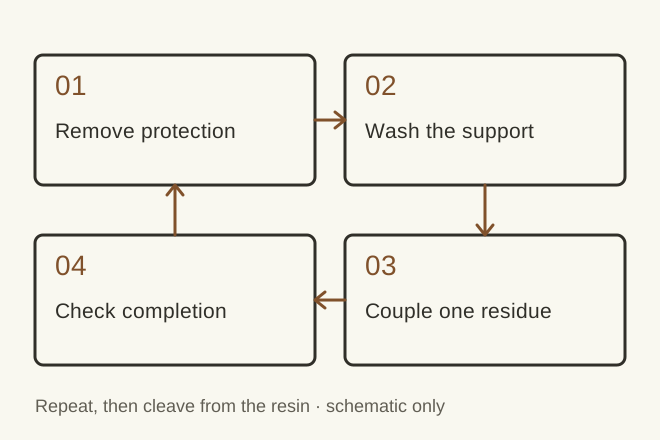
The earlier Fmoc (a temporary chemical protecting group) route assembles protected residues on an amide-forming resin. Selective protection allows the relevant side chains to participate in ring closure while other sites remain protected. N-terminal acetylation is a separate structural feature.
Cyclisation completion needs analytical evidence before recovery proceeds. Cleavage and deprotection can introduce additional changes, including oxidation. The synthesis table documents example process variables, not a validated manufacturing instruction.
What purification must separate
The crude mixture can contain linear chains, incomplete sequences, oxidation products and residual protection. RP-HPLC (reversed-phase high-performance liquid chromatography, which separates mixture components) needs to separate the target from that mixture before fractions are pooled. A large main peak alone does not establish that the ring is correct.
Column selectivity, gradient shape and loading affect this separation. Desalting, solvent removal and freeze-drying follow the selected pool. The recovered mass needs to be interpreted alongside content and counterion measurements.
What release testing can establish
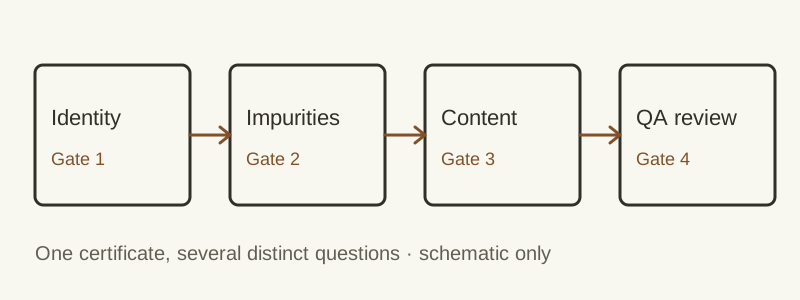
The old panel uses chromatographic comparison and mass-related evidence for identity, alongside impurity profiling and physical checks. Methods need to distinguish the cyclic product from structurally close alternatives. D-configured residues also create a stereochemical question.
Water, residual solvents, counterions and microbiological quality need separate results. The example certificate contains illustrative figures from the earlier page; it does not document a real supplier’s batch or establish safety for administration.
Where stability can be lost
The earlier stability account discusses oxidation, hydrolysis, stereochemical change and aggregation. Hydrolysis breaks susceptible bonds through reaction with water. The significance of each pathway needs to be measured in the actual formulation.
Light protection, moisture control, container closure and shipping conditions are linked study variables. The appendix preserves the old study schedule and packaging examples. Those examples do not establish a universal expiry or a prepared-solution use period.
What the batch record must show
Troubleshooting follows the evidence: low crude purity points back to assembly or closure; poor separation points to the chromatographic method; later purity loss calls for stability and handling review. Batch-to-batch trends need raw-material and process context.
FDA’s page current as of April 22, 2026 lists melanotan II among substances nominated but withdrawn. Withdrawal is not clearance. A public Oath catalogue listing does not change that regulatory position or validate a particular batch.
Technical tables & working schedules
Melanotan-2 tables retain the earlier manufacturing examples. No Melanotan-2 table here validates an operating procedure, release limit or supplier result. The Melanotan-2 examples have no supporting batch raw data; use them to identify document fields, not to infer measured performance.
Melanotan-2 Molecular Specifications7 rows
Inherited manufacturing example. Melanotan-2 settings in this table are unvalidated examples, not supplier specifications or batch results. The Melanotan-2 process and its measurement methods need separate qualification.
| Parameter | Specification |
|---|---|
| Chemical Name | Ac-Nle-cyclo[Asp-His-D-Phe-Arg-Trp-Lys]-NH₂ |
| Molecular Formula | C₅₀H₆₉N₁₅O₉ |
| Molecular Weight | 1024.2 g/mol (free base) |
| CAS Number | 121062-08-6 |
| Peptide Class | Cyclic heptapeptide, α-MSH analog |
| Modifications | N-acetylation, Nle¹, D-Phe⁴, lactam bridge (Asp³-Lys⁸) |
| Counter-ion evidence | Not published |
SPPS Manufacturing Parameters for Melanotan-28 rows
Inherited manufacturing example. Melanotan-2 settings in this table are unvalidated examples, not supplier specifications or batch results. The Melanotan-2 process and its measurement methods need separate qualification.
| Process Step | Reagents/Conditions | Time | Critical Parameters |
|---|---|---|---|
| Resin Loading | Rink amide MBHA (0.4-0.7 mmol/g) | - | Substitution uniformity |
| Fmoc Deprotection | 20% piperidine in DMF | 2 × 5-10 min | Complete removal, avoid aspartimide |
| Amino Acid Coupling | 4-5 eq AA, HBTU/HOBt, DIEA in DMF | 30-60 min | >99% coupling efficiency |
| D-Phe Coupling | 4-5 eq, HATU/HOAt, 0-5°C | 60-90 min | Minimize epimerization (<1%) |
| Mtt Deprotection | 1-2% TFA in DCM | Multiple 5 min cycles | Selective Lys deprotection |
| Lactam Cyclization | PyBOP/DIEA or HATU, dilute conditions | 4-24 hours | >85% cyclization efficiency |
| N-Acetylation | Ac₂O/DIEA in DMF | 30 min | Complete capping |
| Final Cleavage | TFA/TIS/H₂O (95:2.5:2.5) | 2-3 hours | Scavenger optimization |
Preparative HPLC Purification Parameters12 rows
Inherited manufacturing example. Melanotan-2 settings in this table are unvalidated examples, not supplier specifications or batch results. The Melanotan-2 process and its measurement methods need separate qualification.
| Parameter | Specification | Purpose/Notes |
|---|---|---|
| Column Type | C18 reversed-phase, 100-300 Å pore | Hydrophobic interaction separation |
| Particle Size | 5-10 μm | Balance pressure/resolution |
| Column Dimensions | 21.2-50 mm ID × 150-250 mm L | Scale-dependent selection |
| Mobile Phase A | 0.1% TFA in water | Ion-pairing agent |
| Mobile Phase B | 0.1% TFA in acetonitrile | Organic modifier |
| Gradient Profile | 20-50% B over 30-60 min | Optimized for impurity separation |
| Flow Rate | 10-100 mL/min (scale-dependent) | Column diameter optimization |
| Column Temperature | Ambient to 40°C | Resolution enhancement |
| Detection Wavelength | 220 nm (primary), 280 nm (secondary) | Peptide bond and aromatic detection |
| Loading Capacity | 5-20 mg crude/mL column volume | Maintain resolution efficiency |
| Injection Volume | 5-20% column volume | Band broadening minimization |
| Recovery Target | >60% (pure product from crude) | Economic viability threshold |
Analytical QC Testing Panel for Melanotan-213 rows
Inherited manufacturing example. Melanotan-2 settings in this table are unvalidated examples, not supplier specifications or batch results. The Melanotan-2 process and its measurement methods need separate qualification.
| Test | Method | Specification |
|---|---|---|
| Appearance | Visual inspection | White to off-white powder |
| Identity (RT) | RP-HPLC | Conforms to reference ±2% |
| Identity (MW) | ESI-MS or MALDI-TOF | 1024.2 ±1 Da (free base) |
| Amino Acid Composition | AAA (acid hydrolysis) | Conforms to theory ±10-20% |
| Purity (HPLC) | RP-HPLC (area %) | >98.0% |
| Single Impurity | RP-HPLC | <1.0% |
| Total Impurities | RP-HPLC | <2.0% |
| Peptide Content | AAA or qHPLC | >80% (as-is) or >95% (dry basis) |
| Water Content | Karl Fischer | <5.0% |
| Residual TFA | Ion chromatography | Not published |
| Residual Solvents | GC-FID/MS | Per ICH Q3C limits |
| Bacterial Endotoxins | LAL assay | <5 EU/mg |
| Bioburden | Microbial enumeration | <10 CFU/g (if applicable) |
Batch Release Specifications - Pharmaceutical Grade14 rows
Inherited manufacturing example. Melanotan-2 settings in this table are unvalidated examples, not supplier specifications or batch results. The Melanotan-2 process and its measurement methods need separate qualification.
| Parameter | Test Method | Acceptance Criteria |
|---|---|---|
| Appearance | Visual | White to off-white lyophilized powder, no foreign matter |
| Identification (HPLC) | RP-HPLC retention time | Conforms to reference standard ±2% |
| Identification (MS) | ESI-MS | Molecular weight 1024.2 ±1 Da (free base) |
| Sequence Confirmation | Amino acid analysis | Conforms to Ac-Nle-c[Asp-His-D-Phe-Arg-Trp-Lys]-NH₂ |
| Purity by HPLC | RP-HPLC (UV 220nm) | >98.0% (area normalization) |
| Single Largest Impurity | RP-HPLC | <1.0% |
| Total Impurities | RP-HPLC | <2.0% |
| Peptide Content (dry basis) | Quantitative AAA or HPLC | >95.0% |
| Water Content | Karl Fischer titration | <5.0% |
| Acetonitrile (residual) | GC-FID | <410 ppm |
| DMF (residual) | GC-FID | <880 ppm |
| TFA Content | Ion chromatography | Report value |
| Bacterial Endotoxins | LAL kinetic chromogenic | <5.0 EU/mg |
| Heavy Metals | ICP-MS | <10 ppm total |
Stability Storage Conditions and Testing Schedule7 rows
Inherited manufacturing example. Melanotan-2 settings in this table are unvalidated examples, not supplier specifications or batch results. The Melanotan-2 process and its measurement methods need separate qualification.
| Study Type | Condition | Duration | Testing Frequency |
|---|---|---|---|
| Long-term | 25°C ± 2°C / 60% ± 5% RH | 36 months | 0, 3, 6, 9, 12, 18, 24, 36 months |
| Intermediate | 30°C ± 2°C / 65% ± 5% RH | 12 months | 0, 6, 12 months |
| Accelerated | 40°C ± 2°C / 75% ± 5% RH | 6 months | 0, 1, 2, 3, 6 months |
| Refrigerated (long-term) | 5°C ± 3°C | 36 months | 0, 3, 6, 9, 12, 18, 24, 36 months |
| Frozen | -20°C ± 5°C | 36 months | 0, 12, 24, 36 months |
| Freeze-thaw cycling | -20°C to 25°C (3 cycles) | - | After each cycle |
| Photostability | ICH Q1B conditions (1.2M lux-hr) | - | At completion |
Packaging and Storage Specifications9 rows
Inherited manufacturing example. Melanotan-2 settings in this table are unvalidated examples, not supplier specifications or batch results. The Melanotan-2 process and its measurement methods need separate qualification.
| Component | Specification | Purpose |
|---|---|---|
| Primary Container | Amber glass vial (Type I borosilicate) | Light protection, chemical inertness |
| Closure | Butyl rubber stopper, aluminum crimp seal | Hermetic seal, moisture barrier |
| Fill Volume | 2-20 mL vial (manufacturing fill) | Minimize headspace oxidation |
| Desiccant | Silica gel (2-5g) or molecular sieve | Humidity control <20% RH |
| Atmosphere | Nitrogen or argon purge | Oxygen exclusion (<2% O₂) |
| Secondary Packaging | Cardboard carton with product insert | Physical protection, labeling |
| Storage Temperature | 2-8°C (refrigerated) | Optimal stability (24-36 mo shelf life) |
| Alternative Storage | -20°C (frozen) | Extended stability (>36 months) |
| Shipping Conditions | 2-8°C with temperature monitoring | Cold chain maintenance |
Example Certificate of Analysis - Batch MT2-2024-123411 rows
Illustrative record retained from the earlier edition. These Melanotan-2 examples have no verified measurement dataset and cannot establish a batch result or supplier performance.
| Test Parameter | Method | Specification | Result |
|---|---|---|---|
| Appearance | Visual | White to off-white powder | White powder |
| Identification (HPLC RT) | RP-HPLC | Conforms ±2% | Conforms (12.34 min) |
| Identification (MS) | ESI-MS | 1024.2 ±1 Da | 1024.5 Da |
| Purity (HPLC) | RP-HPLC (220nm) | >98.0% | 98.7% |
| Single Impurity (max) | RP-HPLC | <1.0% | 0.4% |
| Total Impurities | RP-HPLC | <2.0% | 1.3% |
| Peptide Content (dry) | AAA | >95.0% | 97.2% |
| Water Content | Karl Fischer | <5.0% | 3.1% |
| TFA Content | Ion chromatography | Report | 15.3% (w/w) |
| Acetonitrile (residual) | GC-FID | <410 ppm | 22 ppm |
| Bacterial Endotoxins | LAL kinetic | <5.0 EU/mg | <0.5 EU/mg |
Source register
Melanotan-2 source links are retained below. These references give context for Melanotan-2 manufacturing; they do not validate the numerical examples. Duplicate Melanotan-2 source links retain the citation record.
- Bednarek MA, et al. "Structure-function studies on the cyclic peptide MT-II, lactam derivative of alpha-melanotropin." Journal of Medicinal Chemistry. 1994;37(11):1558-1569. https://pubs.acs.org/doi/10.1021/jm00037a009
- International Conference on Harmonisation (ICH). "ICH Q7: Good Manufacturing Practice Guide for Active Pharmaceutical Ingredients." November 2000. https://www.ich.org/page/quality-guidelines
- Chan WC, White PD. Fmoc Solid Phase Peptide Synthesis: A Practical Approach. Oxford University Press; 2000. https://global.oup.com/academic/product/fmoc-solid-phase-peptide-synthesis-9780199637256
- Albericio F, Kruger HG. "Therapeutic peptides." Future Medicinal Chemistry. 2012;4(12):1527-1531. https://www.future-science.com/doi/10.4155/fmc.12.94
- ICH Harmonised Guideline. "Stability testing of new drug substances and products Q1A(R2)." February 2003. https://database.ich.org/sites/default/files/Q1A%28R2%29%20Guideline.pdf
- Palian MM, et al. "Analysis of the covalent structure of peptides and proteins." Current Protocols in Protein Science. 2016;Chapter 11:Unit 11.1.1-11.1.56. https://currentprotocols.onlinelibrary.wiley.com/doi/10.1002/0471140864.ps1101s84
- Henninot A, et al. "The Current State of Peptide Drug Discovery: Back to the Future?" Journal of Medicinal Chemistry. 2018;61(4):1382-1414. https://pubs.acs.org/doi/10.1021/acs.jmedchem.7b00318
- Valeur E, Bradley M. "Amide bond formation: beyond the myth of coupling reagents." Chemical Society Reviews. 2009;38(2):606-631. https://pubs.rsc.org/en/content/articlelanding/2009/cs/b701677h
- U.S. Food and Drug Administration. "Guidance for Industry: Q3C — Tables and List." Center for Drug Evaluation and Research (CDER), November 2017. https://www.fda.gov/regulatory-information/search-fda-guidance-documents/q3c-tables-and-list-guidance-industry
- Banga AK, editor. Therapeutic Peptides and Proteins: Formulation, Processing, and Delivery Systems. 3rd ed. CRC Press; 2015. https://www.taylorfrancis.com/books/mono/10.1201/b18392/therapeutic-peptides-proteins-ashim-banga