What has to be made
The earlier profile describes the pentapeptide Aib-His-D-2-Nal-D-Phe-Lys-NH₂. Aib and D-2-Nal are non-standard building blocks in this sequence. Their identity, orientation and incorporation need to match the product specification.
The old tables cover synthesis, purification, analytical testing and release. Their numerical ranges remain illustrative reference material. Neither the sequence name nor a public supplier listing establishes that a particular batch meets them.
How the chain is assembled
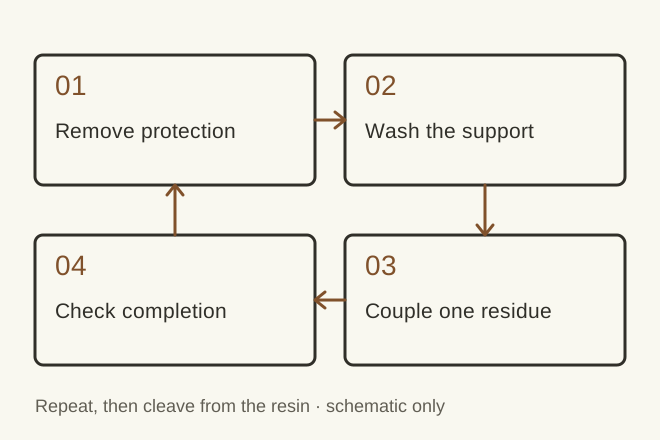
The described Fmoc (a temporary chemical protecting group) route uses an amide-forming support. The protected building blocks, resin loading, coupling system and deprotection checks affect whether the intended chain is obtained. Steric hindrance means bulky groups can make a reaction site harder to reach.
The earlier account discusses activation reagents, monitoring and acid cleavage with scavengers. Crude-product analysis checks the result before expensive downstream work. It does not replace a final method capable of distinguishing related or incorrectly configured peptides.
What purification must separate
RP-HPLC (reversed-phase high-performance liquid chromatography, which separates mixture components) provides the main separation. Solvent modifiers and gradient development influence how well the target separates from close impurities. The earlier scale and loading examples need qualification on the actual column and equipment.
The final pool then undergoes desalting and freeze-drying. Residual counterions and water contribute to the weighed powder, so gross recovery and measured peptide content need separate records. Drying and packaging choices should be connected to stability data.
What release testing can establish
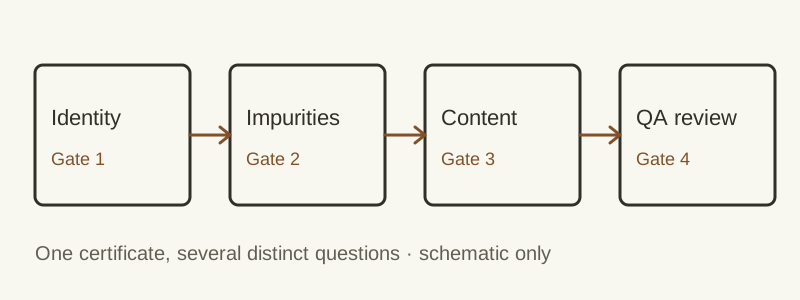
The old analytical account combines mass spectrometry, chromatographic comparison, composition and related-substance testing. Peptide content corrects for material such as counterions and water. HPLC peak-area purity alone cannot establish that content.
Residual-solvent testing, water measurement, endotoxin, bioburden and sterility where applicable answer other release questions. The retained panels are example specifications. Actual results, qualified standards and method suitability are needed for an individual batch.
Where stability can be lost
The earlier profile considers chemical change, aggregation and light exposure. Each proposed degradation pathway needs an analytical method that can show whether it occurs in the particular material. Long-term and stress studies answer different questions.
Powder storage and transport depend on container and stability evidence. A freeze-dried powder’s example shelf life should not be carried across to a prepared solution.
What the batch record must show
The old validation lifecycle connects process design, qualification and continued monitoring. During scale-up, mixing, heat transfer and chromatographic loading change. The batch record should show raw-material traceability, deviations, yield reconciliation, changes and an authorised release decision.
FDA’s page identifies ipamorelin acetate in Category 2 for 503B only, on the page current as of April 22, 2026. That statement must not be broadened into a classification of every form or a claim about 503A. An Oath catalogue listing is not drug approval.
Technical tables & working schedules
Ipamorelin tables retain the earlier manufacturing examples. No Ipamorelin table here validates an operating procedure, release limit or supplier result. The Ipamorelin examples have no supporting batch raw data; use them to identify document fields, not to infer measured performance.
SPPS Process Parameters for Ipamorelin Manufacturing6 rows
Inherited manufacturing example. Ipamorelin settings in this table are unvalidated examples, not supplier specifications or batch results. The Ipamorelin process and its measurement methods need separate qualification.
| Process Step | Reagent/Conditions | Duration | Temperature | Acceptance Criteria |
|---|---|---|---|---|
| Resin Swelling | DMF/DCM | 30-60 min | 20-25°C | Complete resin expansion |
| Fmoc Deprotection | 20% Piperidine/DMF | 3 min + 10 min | 20-25°C | UV₃₀₁ baseline return |
| Amino Acid Coupling | HBTU/DIEA/DMF | 1-4 hours | 20-25°C | >99.5% coupling yield |
| Capping (Optional) | Ac₂O/DIEA/DMF | 5-10 min | 20-25°C | Negative Kaiser test |
| Final Cleavage | TFA cocktail + scavengers | 2-4 hours | 20-25°C | Complete peptide release |
| Precipitation | Cold diethyl ether | N/A | -20 to 4°C | White to off-white precipitate |
Purification Process Parameters and Specifications7 rows
Inherited manufacturing example. Ipamorelin settings in this table are unvalidated examples, not supplier specifications or batch results. The Ipamorelin process and its measurement methods need separate qualification.
| Parameter | Laboratory Scale | Production Scale | Specification |
|---|---|---|---|
| Column Dimensions | 250 x 21.2 mm | 250 x 100-150 mm | L/D ratio: 2.5-10 |
| Particle Size | 5-10 μm | 10-20 μm | C18, 100-300 Å |
| Flow Rate | 10-20 mL/min | 100-500 mL/min | Linear velocity: 200-400 cm/hr |
| Loading Capacity | 50-100 mg/g | 100-200 mg/g | Optimized for resolution |
| Gradient Slope | 0.5-1.0 %B/min | 0.3-0.7 %B/min | 20-40% acetonitrile range |
| Collection Threshold | Target peak ≥95% purity | Target peak ≥95% purity | UV detection 214/280 nm |
| Recovery Yield | 60-80% | 65-85% | Based on crude input |
Analytical Testing Methods and Acceptance Criteria10 rows
Inherited manufacturing example. Ipamorelin settings in this table are unvalidated examples, not supplier specifications or batch results. The Ipamorelin process and its measurement methods need separate qualification.
| Test Parameter | Methodology | Specification | Frequency |
|---|---|---|---|
| Appearance | Visual Inspection | White to off-white lyophilized powder | Each batch |
| Identity | HRMS (ESI or MALDI-TOF) | [M+H]⁺ = 712.85 ± 0.1 m/z | Each batch |
| Identity (secondary) | RP-HPLC retention time | Matches reference standard ± 2% | Each batch |
| Purity | RP-HPLC (214 nm) | ≥98.0% by area normalization | Each batch |
| Single Impurity | RP-HPLC (214 nm) | ≤1.0% individual impurity | Each batch |
| Total Impurities | RP-HPLC (214 nm) | ≤2.0% total | Each batch |
| Peptide Content | Quantitative AAA | 75-95% (as is basis) | Each batch |
| Water Content | Karl Fischer titration | ≤5.0% | Each batch |
| TFA Content | Ion chromatography | Not published | Each batch |
| Bacterial Endotoxin | LAL or recombinant Factor C | ≤5.0 EU/mg | Each batch |
Manufacturing Batch Specification Summary10 rows
Inherited manufacturing example. Ipamorelin settings in this table are unvalidated examples, not supplier specifications or batch results. The Ipamorelin process and its measurement methods need separate qualification.
| Attribute | Target Specification | Test Method | Critical Quality Attribute |
|---|---|---|---|
| Molecular Weight | 711.85 g/mol (theoretical) | HRMS | Yes |
| Molecular Formula | C₃₈H₄₉N₉O₅ | HRMS + AAA | Yes |
| Main Peak Purity | ≥98.0% | RP-HPLC (214 nm) | Yes |
| Net Peptide Content | 75-95% (as is) | Quantitative AAA | Yes |
| Optical Activity | [α]D: -65 to -75° (c=1, AcOH) | Polarimetry | No |
| Solubility | Soluble in water, DMSO, AcOH | Visual observation | No |
| pH (1% solution) | 3.5-5.5 | pH meter | No |
| Bacterial Endotoxin | ≤5.0 EU/mg | LAL or rFC | Yes |
| Sterility (if required) | No growth | USP <71> or Ph.Eur. 2.6.1 | Yes |
| Heavy Metals | ≤10 ppm | ICP-MS | Yes |
Stability Testing Conditions and Acceptance Criteria6 rows
Inherited manufacturing example. Ipamorelin settings in this table are unvalidated examples, not supplier specifications or batch results. The Ipamorelin process and its measurement methods need separate qualification.
| Study Type | Storage Condition | Duration | Testing Intervals | Acceptance Criteria |
|---|---|---|---|---|
| Long-term | -20°C ± 5°C | 36 months | 0, 3, 6, 9, 12, 18, 24, 36 months | Purity ≥98.0%, Content 90-110% initial |
| Long-term (refrigerated) | 5°C ± 3°C | 24 months | 0, 3, 6, 9, 12, 18, 24 months | Purity ≥98.0%, Content 90-110% initial |
| Accelerated | 25°C ± 2°C / 60% RH ± 5% | 6 months | 0, 1, 2, 3, 6 months | Purity ≥95.0%, Content 90-110% initial |
| Stressed (thermal) | 40°C ± 2°C / 75% RH ± 5% | 3 months | 0, 1, 2, 3 months | Characterize degradation pathways |
| Photostability | 1.2M lux·hr + 200 W·hr/m² | Single timepoint | Post-exposure | Demonstrate photostability or justify protection |
| Freeze-thaw | -80°C to +25°C cycles | 5 cycles | After each cycle | Purity ≥98.0%, No aggregation |
Storage and Handling Specifications4 rows
Inherited manufacturing example. Ipamorelin settings in this table are unvalidated examples, not supplier specifications or batch results. The Ipamorelin process and its measurement methods need separate qualification.
| Product Form | Storage Temperature | Additional Conditions | Shelf Life |
|---|---|---|---|
| Lyophilized powder (sealed) | -20°C ± 5°C | Protected from light and moisture, in sealed container | 24-36 months |
| Lyophilized powder (sealed) | 2-8°C | Protected from light and moisture, in sealed container | 12-24 months |
| Solution stability evidence | Not published | Not published | Not published |
| Shipping/transit | 2-8°C or frozen | Validated cold chain, temperature monitoring | Not published |
Certificate of Analysis Required Information Elements9 rows
Illustrative record retained from the earlier edition. These Ipamorelin examples have no verified measurement dataset and cannot establish a batch result or supplier performance.
| Section | Required Information | Purpose |
|---|---|---|
| Product Identification | Name, CAS#, molecular formula, molecular weight, structure | Confirms product identity |
| Batch Information | Lot/batch number, manufacturing date, expiration date, quantity | Enables traceability |
| Manufacturer Information | Company name, address, contact, regulatory registrations | Establishes manufacturer identity |
| Storage Conditions | Recommended storage temperature, protection requirements | Guides proper handling |
| Test Results | Parameter, method, specification, result, conformance status | Documents quality compliance |
| QA Approval | QA signature/approval, date, title | Authorizes batch release |
| Regulatory Statements | Intended use limitations, regulatory disclaimers | Communicates use restrictions |
| Document Control | CoA number, issue date, revision status, page numbering | Enables version control |
| Supplemental Data (optional) | HPLC chromatogram, mass spectrum, amino acid analysis data | Provides additional verification |
Source register
Ipamorelin source links are retained below. These references give context for Ipamorelin manufacturing; they do not validate the numerical examples. Duplicate Ipamorelin source links retain the citation record.
- 1
- 2
- 3
- 4
- 5
- 6
- 7
- 8
- 9
- Oath Research
- 10
- Coin I, Beyermann M, Bienert M. "Solid-phase peptide synthesis: from standard procedures to the synthesis of difficult sequences." Nature Protocols. 2007;2(12):3247-3256. Available at: https://www.ncbi.nlm.nih.gov/pmc/articles/PMC6315689/
- Amblard M, Fehrentz JA, Martinez J, Subra G. "Methods and protocols of modern solid phase peptide synthesis." Molecular Biotechnology. 2006;33(3):239-254. Available at: https://www.sciencedirect.com/science/article/pii/S0040402013012345
- Fekete S, Guillarme D, Dong MW. "Chromatographic and mass spectrometric strategies for peptide bioanalysis and purification." Chromatography Today. 2019. Available at: https://www.chromatographytoday.com/news/hplc-uhplc/31/breaking-news/peptide-purification-strategies-for-pharmaceutical-manufacturing/58923
- Patel SM, Doen T, Pikal MJ. "Determination of end point of primary drying in freeze-drying process control." American Pharmaceutical Review. 2010. Available at: https://www.americanpharmaceuticalreview.com/Featured-Articles/188841-Lyophilization-Process-Development-and-Optimization/
- International Council for Harmonisation (ICH). "ICH Q2(R1): Validation of Analytical Procedures: Text and Methodology." 2005. Available at: https://www.ich.org/page/quality-guidelines
- U.S. Food and Drug Administration. "Q3B(R2) Impurities in New Drug Products." ICH Guidance. 2006. Available at: https://www.fda.gov/regulatory-information/search-fda-guidance-documents/q3b-r2-impurities-new-drug-products
- U.S. Food and Drug Administration. "Investigating Out-of-Specification (OOS) Test Results for Pharmaceutical Production." 2006. Available at: https://www.fda.gov/regulatory-information/search-fda-guidance-documents/investigating-out-specification-oos-test-results-pharmaceuticals
- International Council for Harmonisation (ICH). "Q1A(R2): Stability Testing of New Drug Substances and Products." 2003. Available at: https://database.ich.org/sites/default/files/Q1A%28R2%29%20Guideline.pdf
- United States Pharmacopeia (USP). "General Chapter <1079>: Good Storage and Distribution Practices for Drug Products." Available at: https://www.usp.org/harmonization-standards/pdg/general-chapters/storage-distribution
- U.S. Food and Drug Administration. "Guidance for Industry: Part 11, Electronic Records; Electronic Signatures — Scope and Application." 2003. Available at: https://www.fda.gov/media/71001/download