What has to be made
GHRP-2 is a synthetic hexapeptide in the earlier manufacturing profile. Its identity depends on the exact building blocks and their D or L configuration: two different orientations of an amino acid that can produce peptides with the same mass.
The old molecular and impurity tables contain unverified example assignments. They are retained for reference rather than presented as a definitive structural catalogue. A project needs an agreed sequence and a qualified reference standard before those assignments can support a release decision.
How the chain is assembled
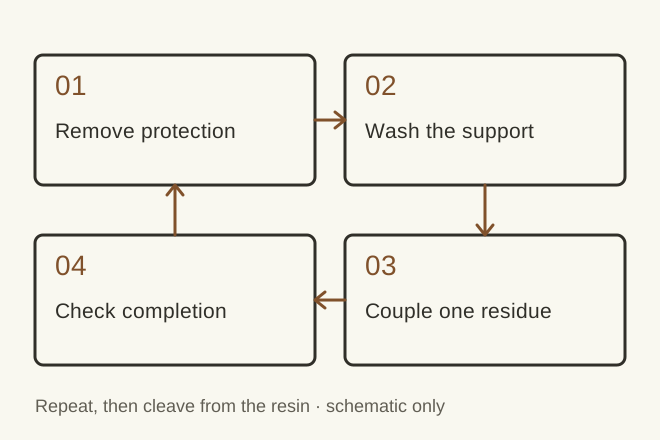
The earlier Fmoc (a temporary chemical protecting group) route uses an amide-forming resin and position-specific coupling controls. Protected building-block identity and optical purity, meaning the proportion in the intended orientation, are inputs worth checking before chain assembly.
Deprotection, coupling and cleavage records help explain deletion products or changes at difficult residues. The earlier process description also covers scavengers and crude recovery. A satisfactory crude mass spectrum is a checkpoint, not a complete stereochemical analysis.
What purification must separate
Preparative RP-HPLC (reversed-phase high-performance liquid chromatography, which separates mixture components) provides the main separation, followed by polishing when the first pool contains unresolved related peptides. Fractions need analytical review before being combined. The numerical gradient and loading examples below are not validated settings.
Desalting and TFA exchange change the counterion contribution to the final powder. Freeze-drying then controls physical form and water content. Purification recovery should be reconciled against measured peptide content, not only the gross weight of material collected.
What release testing can establish
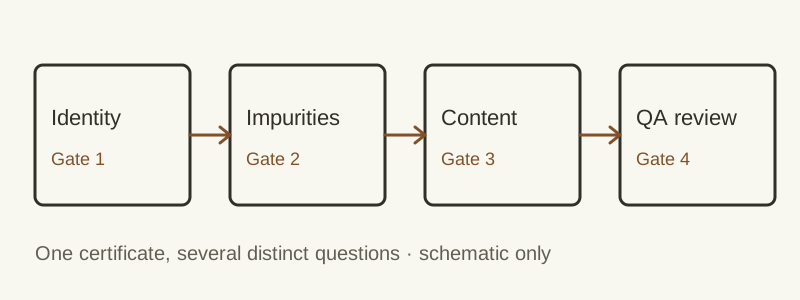
Chromatographic purity, mass confirmation, amino acid analysis and stereochemical analysis supply different information. The earlier advanced-characterisation section also discusses high-resolution mass spectrometry, NMR (nuclear magnetic resonance, which probes molecular structure) and sequence mapping. Each method needs to be appropriate for this short, modified sequence.
Residual solvents, counterions, water and microbiological tests complete different parts of the panel. The retained impurity table should be treated cautiously: its hypothetical structures and ranges were not backed by raw spectra in the supplied page. A sample certificate is likewise illustrative.
Where stability can be lost
The older programme examines oxidation, related-peptide formation, light stress and temperature changes. Long-term, accelerated and stress studies have different purposes; stress data help identify pathways rather than automatically establish shelf life.
Powder storage, container closure, shipping logs and excursion review belong in the same evidence chain. Solution stability still requires a separate study.
What the batch record must show
Raw-material qualification and reference-standard management support every subsequent result. A complete batch record connects those materials with synthesis, purification, drying and authorised release. Scale-up also needs evidence for mixing, heat transfer, equipment performance and method transfer.
FDA’s page current as of April 22, 2026 identifies GHRP-2 as remaining in Category 2. This regulatory classification and an individual batch’s manufacturing quality are separate questions.
Technical tables & working schedules
GHRP-2 tables retain the earlier manufacturing examples. No GHRP-2 table here validates an operating procedure, release limit or supplier result. The GHRP-2 examples have no supporting batch raw data; use them to identify document fields, not to infer measured performance.
GHRP-2 Molecular Specifications7 rows
Inherited manufacturing example. GHRP-2 settings in this table are unvalidated examples, not supplier specifications or batch results. The GHRP-2 process and its measurement methods need separate qualification.
| Parameter | Specification | Method Reference |
|---|---|---|
| Chemical Name | D-Alanyl-3-(2-naphthyl)-D-alanyl-L-alanyl-L-tryptophyl-D-phenylalanyl-L-lysinamide | IUPAC Nomenclature |
| Sequence | D-Ala-D-2-Nal-Ala-Trp-D-Phe-Lys-NH2 | Standard Three-Letter Code |
| Molecular Formula | C45H55N9O6 | Elemental Analysis |
| Molecular Weight | 817.97 Da (free base) | Mass Spectrometry (ESI-MS) |
| CAS Number | 158861-67-7 | Chemical Abstracts Service |
| Appearance | White to off-white lyophilized powder | Visual Inspection |
| Solubility | Freely soluble in water, DMSO; sparingly soluble in ethanol | Ph. Eur. 2.9.40 |
Standard Coupling Cycle Parameters7 rows
Inherited manufacturing example. GHRP-2 settings in this table are unvalidated examples, not supplier specifications or batch results. The GHRP-2 process and its measurement methods need separate qualification.
| Step | Reagent/Condition | Duration | Temperature |
|---|---|---|---|
| Resin Swelling | DMF | 15 min | 25°C |
| Fmoc Deprotection | 20% piperidine in DMF | 2 × 5 min | 25°C |
| Wash | DMF | 5 × 1 min | 25°C |
| Amino Acid Activation | Fmoc-AA (4 eq), HBTU (3.95 eq), DIPEA (6 eq) in DMF | 2 min | 25°C |
| Coupling | Activated amino acid solution | 45-60 min | 25-40°C |
| Wash | DMF | 5 × 1 min | 25°C |
| Coupling Verification | Ninhydrin or Kaiser test | 5 min | 100°C (test) |
Preparative Purification Parameters8 rows
Inherited manufacturing example. GHRP-2 settings in this table are unvalidated examples, not supplier specifications or batch results. The GHRP-2 process and its measurement methods need separate qualification.
| Parameter | Specification | Rationale |
|---|---|---|
| Column | C18, 250 × 50 mm, 10 μm | Adequate loading capacity for preparative scale |
| Mobile Phase A | 0.1% TFA in water | Ion pairing and pH control |
| Mobile Phase B | 0.1% TFA in acetonitrile | Organic modifier for peptide elution |
| Gradient | 15-35% B over 45 min | Optimized resolution of target from impurities |
| Flow Rate | 80-100 mL/min | Balance of resolution and throughput |
| Detection | UV 220 nm, 280 nm | Peptide bond and aromatic monitoring |
| Column Temperature | 25 ± 2°C | Temperature control for reproducibility |
| Load Concentration | 50-100 mg/mL | Column capacity optimization |
Purity Specifications and Testing Methods7 rows
Inherited manufacturing example. GHRP-2 settings in this table are unvalidated examples, not supplier specifications or batch results. The GHRP-2 process and its measurement methods need separate qualification.
| Test | Method | Specification |
|---|---|---|
| Purity (HPLC) | RP-HPLC, UV 220 nm | ≥98.0% |
| Single Largest Impurity | RP-HPLC, UV 220 nm | ≤1.0% |
| Total Impurities | RP-HPLC, UV 220 nm | ≤2.0% |
| Tryptophan Oxidation | RP-HPLC, fluorescence detection | ≤0.5% |
| D/L Isomerization | Chiral HPLC | ≤0.5% each position |
| Deletion Sequences | LC-MS | ≤0.3% individual |
| Related Peptides | RP-HPLC | Report values ≥0.1% |
Critical In-Process Controls8 rows
Inherited manufacturing example. GHRP-2 settings in this table are unvalidated examples, not supplier specifications or batch results. The GHRP-2 process and its measurement methods need separate qualification.
| Process Stage | Control Parameter | Acceptance Criteria | Action on Failure |
|---|---|---|---|
| Resin Preparation | Loading capacity | 0.45-0.55 mmol/g | Reject resin lot |
| Each Coupling | Ninhydrin test | Negative (blue color absent) | Repeat coupling cycle |
| Deprotection | UV absorbance (301 nm) | ≥95% of theoretical | Extend deprotection time |
| Crude Cleavage | HPLC purity | ≥50% | Investigate synthesis failure |
| Post-Prep HPLC | Pool purity | ≥90% | Re-purify or discard |
| Post-Polish HPLC | Purity | ≥98% | Additional polishing step |
| Pre-Lyophilization | TFA content | ≤0.5% w/w | Additional desalting |
| Post-Lyophilization | Moisture content | ≤3.0% | Extended secondary drying |
Stability Study Design and Acceptance Criteria8 rows
Inherited manufacturing example. GHRP-2 settings in this table are unvalidated examples, not supplier specifications or batch results. The GHRP-2 process and its measurement methods need separate qualification.
| Study Type | Conditions | Duration | Testing Frequency |
|---|---|---|---|
| Long-Term | -20°C ± 5°C | 36-60 months | 0, 3, 6, 9, 12, 18, 24, 36, 48, 60 months |
| Accelerated | 5°C ± 3°C | 12 months | 0, 3, 6, 12 months |
| Intermediate | 25°C/60% RH ± 2°C/5% RH | 6 months | 0, 3, 6 months |
| Stress Testing | 40°C/75% RH ± 2°C/5% RH | 3 months | 0, 1, 2, 3 months |
| Freeze-Thaw | -20°C to 25°C cycles | 5 cycles | After each cycle |
| Light Exposure | ICH Option 2 (1.2M lux·hr visible, 200 W·hr/m² UV) | Single timepoint | End of exposure |
| pH Stability | pH 2, 4, 7, 9 at 25°C | 7 days | 0, 1, 3, 7 days |
| Oxidative Stress | 0.1% H₂O₂ at 25°C | 24 hours | 0, 6, 24 hours |
Storage and Handling Specifications8 rows
Inherited manufacturing example. GHRP-2 settings in this table are unvalidated examples, not supplier specifications or batch results. The GHRP-2 process and its measurement methods need separate qualification.
| Parameter | Specification/Recommendation |
|---|---|
| Long-Term Storage (Lyophilized) | -20°C ± 5°C, protect from light and moisture |
| Short-Term Storage (Lyophilized) | 2-8°C for up to 30 days |
| Shelf-Life (Lyophilized, -20°C) | 24-36 months from date of manufacture |
| Recommended Diluents | Sterile water, 10 mM acetic acid, sterile saline |
| Solution pH Range (Optimal Stability) | pH 4.0-5.5 |
| Light Protection | Required at all times (amber vials or foil wrap) |
| Container Type | USP Type I borosilicate glass |
| Desiccant Requirement | Included in secondary packaging |
Representative Certificate of Analysis Data9 rows
Illustrative record retained from the earlier edition. These GHRP-2 examples have no verified measurement dataset and cannot establish a batch result or supplier performance.
| Test | Method | Specification | Result (Batch Example) |
|---|---|---|---|
| Appearance | Visual | White to off-white powder | White powder |
| Identity (MS) | ESI-MS | 817.97 ± 0.5 Da | 818.2 Da (M+H)⁺ |
| Identity (HPLC) | RP-HPLC | RT = 18.5 ± 0.4 min | RT = 18.3 min |
| Purity (HPLC) | RP-HPLC, 220 nm | ≥98.0% | 98.7% |
| Water Content | Karl Fischer | ≤3.0% | 2.1% |
| TFA Content | Ion Chromatography | ≤0.5% | 0.3% |
| Peptide Content | Amino Acid Analysis | ≥95% | 97.2% |
| Single Impurity | RP-HPLC, 220 nm | ≤1.0% | 0.6% |
| Total Impurities | RP-HPLC, 220 nm | ≤2.0% | 1.3% |
Common GHRP-2 Impurity Profile7 rows
Inherited manufacturing example. GHRP-2 settings in this table are unvalidated examples, not supplier specifications or batch results. The GHRP-2 process and its measurement methods need separate qualification. The hypothetical impurity assignments were not verified against raw spectra or an agreed sequence and are not an identification standard.
| Impurity Type | Structure/Description | Published evidence | Detection Method |
|---|---|---|---|
| Des-Lys⁶ GHRP-2 | Deletion sequence missing C-terminal lysine | Not published | LC-MS (MW 689.8 Da) |
| Des-Ala¹ GHRP-2 | Deletion sequence missing N-terminal D-alanine | Not published | LC-MS (MW 747.0 Da) |
| Trp-Oxidation Products | Tryptophan oxidized to N-formylkynurenine (+16 Da) | Not published | LC-MS, fluorescence detection |
| Phe Substitution | L-Phe in place of D-Phe (stereoisomer) | Not published | Chiral HPLC |
| Incomplete Deprotection | Residual Boc group on lysine (+100 Da) | Not published | LC-MS (MW 918.0 Da) |
| Dimers | Disulfide-linked or non-covalent aggregates | Not published | SEC, native MS |
| TFA Adducts | TFA ester formation on hydroxyl groups | Not published | LC-MS (+96 Da) |
Source register
GHRP-2 source links are retained below. These references give context for GHRP-2 manufacturing; they do not validate the numerical examples. Duplicate GHRP-2 source links retain the citation record.
- current Good Manufacturing Practice (cGMP) regulations
- Fmoc chemistry over Boc chemistry
- mobile phase optimization
- lyophilization cycles
- ICH Q6A specifications
- ICH Q1A(R2) guidelines
- ICH quality guidelines
- Quality by Design (QbD) principles
- International Conference on Harmonisation (ICH). Q7 Good Manufacturing Practice Guidance for Active Pharmaceutical Ingredients. Available at: https://database.ich.org/sites/default/files/Q7%20Guideline.pdf
- U.S. Food and Drug Administration. Current Good Manufacturing Practice (CGMP) Regulations. Available at: https://www.fda.gov/drugs/pharmaceutical-quality-resources/current-good-manufacturing-practice-cgmp-regulations
- Merrifield RB. Solid Phase Peptide Synthesis. I. The Synthesis of a Tetrapeptide. J Am Chem Soc. 1963;85(14):2149-2154. Available at: https://pubs.acs.org/doi/10.1021/ja00897a025
- Sigma-Aldrich. Fmoc Solid Phase Peptide Synthesis - A Practical Approach. Technical Article. Available at: https://www.sigmaaldrich.com/US/en/technical-documents/technical-article/chemistry-and-synthesis/peptide-synthesis/fmoc-solid-phase-peptide-synthesis
- Waters Corporation. HPLC Fundamentals - Principles and Practice. Available at: https://www.waters.com/waters/en_US/HPLC-Fundamentals/nav.htm?cid=10049055
- International Conference on Harmonisation (ICH). Q6A Specifications: Test Procedures and Acceptance Criteria for New Drug Substances and New Drug Products: Chemical Substances. Available at: https://database.ich.org/sites/default/files/Q6A_Guideline.pdf
- International Conference on Harmonisation (ICH). Q1A(R2) Stability Testing of New Drug Substances and Products. Available at: https://database.ich.org/sites/default/files/Q1A%28R2%29%20Guideline.pdf
- U.S. Food and Drug Administration. Lyophilization of Parenteral Drug Products - Guidance for Industry. Available at: https://www.fda.gov/regulatory-information/search-fda-guidance-documents/lyophilization-parenteral-drug-products
- International Conference on Harmonisation (ICH). Quality Guidelines Overview. Available at: https://www.ich.org/page/quality-guidelines
- International Conference on Harmonisation (ICH). Q8(R2) Pharmaceutical Development. Available at: https://www.fda.gov/regulatory-information/search-fda-guidance-documents/q8r2-pharmaceutical-development