What has to be made
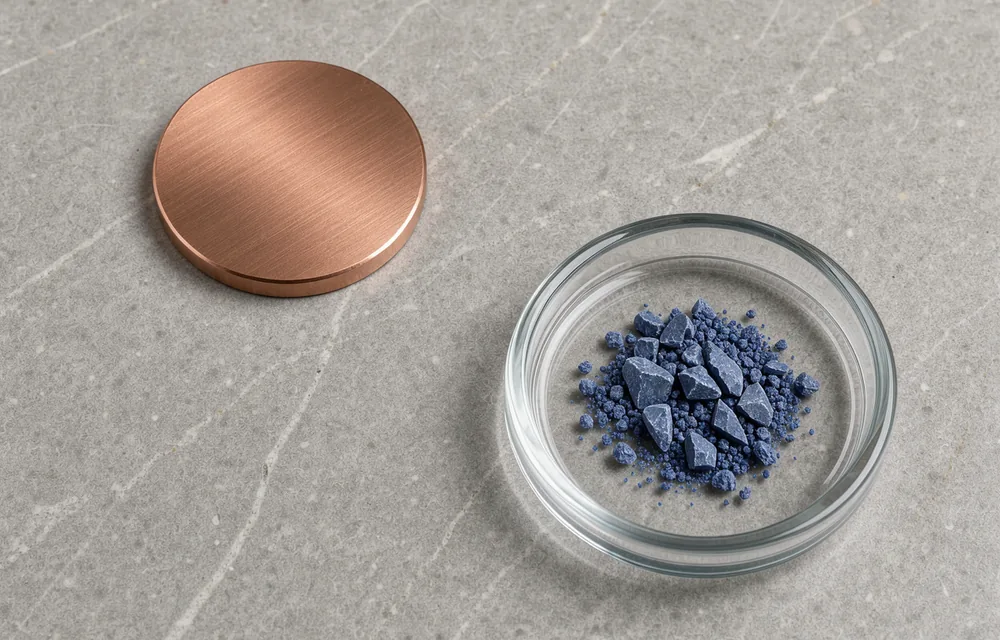
GHK-Cu combines the tripeptide glycyl-histidyl-lysine with copper. Coordination is the binding of a metal ion to groups on the peptide. The blue colour is a useful observation, but it cannot establish the complete identity or purity of a batch.
The earlier page discusses terminal forms without consistently separating their specifications. The intended GHK form must therefore be established from the actual sequence specification and analytical record. Its resin and release tables are inherited examples, not proof of a particular terminal form.
How the chain is assembled
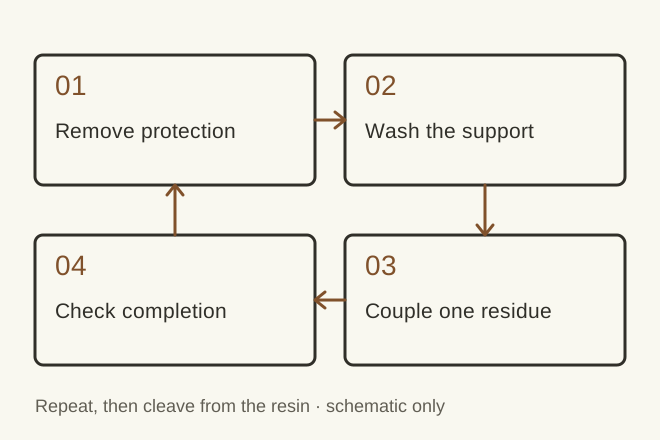
The described process first assembles the GHK chain with protected amino acids. Histidine protection and coupling conditions matter because unwanted changes can alter the later copper-binding material. Cleavage removes the chain from the support and releases the protected side chains.
Copper complex formation is a distinct operation. The older account compares copper salts and tracks pH, mixing, temperature and the copper-to-peptide ratio. Those variables affect whether the record describes the intended complex, excess free copper or material lost through precipitation.
What purification must separate
The earlier route uses chromatographic separation to address uncomplexed peptide, deletion products and other residues. Separation conditions need to preserve the form being measured; a method that changes the complex cannot by itself describe the starting mixture.
Fraction pooling, solvent removal and counterion exchange need to be linked to a final identity check. The technical appendix retains the old example parameters. They should be assessed alongside the actual complex’s behaviour rather than treated as a universal purification recipe.
What release testing can establish
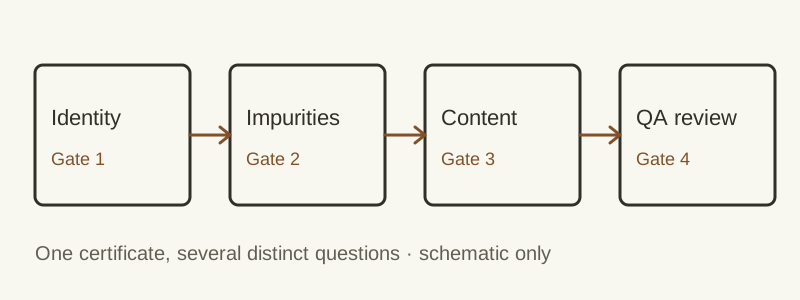
Mass, chromatographic behaviour and composition address peptide identity. Copper measurement by elemental analysis answers another question: how much metal is present. The amount of copper and the proportion bound in the intended form should not be treated as interchangeable results.
The earlier panel also covers water, counterions, residual solvents, related substances and microbial quality. A batch certificate needs actual results and method references for the claims it makes. Neither colour nor a single HPLC peak establishes all of them.
Where stability can be lost
The older stability account highlights copper dissociation, where the metal separates from the peptide, alongside chemical degradation. Light, moisture, pH and the container can change the mixture. A stability method needs to distinguish those changes rather than report colour alone.
Frozen, refrigerated and room-temperature studies are retained as study topics. Their example schedules do not establish shelf life for a new formulation. Cleaning and handling controls also need to address copper-containing residues between batches.
What the batch record must show
The record should distinguish peptide synthesis, complex formation, purification and final release. It should include the copper source, raw-material lots, in-process observations, cleaning checks, calibration, deviations and change control. Equipment qualification and process validation address different parts of this chain.
On FDA’s page current as of April 22, 2026, GHK-Cu for injectable routes is listed among substances nominated but withdrawn. Withdrawal is not clearance. Topical cosmetic use is a separate regulatory context; a cosmetic ingredient is not an FDA-approved injectable drug.
Technical tables & working schedules
GHK-Cu tables retain the earlier manufacturing examples. No GHK-Cu table here validates an operating procedure, release limit or supplier result. The GHK-Cu examples have no supporting batch raw data; use them to identify document fields, not to infer measured performance.
SPPS Parameters for GHK Manufacturing7 rows
Inherited manufacturing example. GHK-Cu settings in this table are unvalidated examples, not supplier specifications or batch results. The GHK-Cu process and its measurement methods need separate qualification. The inherited amide-forming support is not a confirmed route to every GHK terminal form; establish the target before assessing this route.
| Parameter | Specification | Rationale |
|---|---|---|
| Resin Type | Rink Amide MBHA, 100-200 mesh | C-terminal amide formation, optimal swelling |
| Resin Loading | 0.4-0.5 mmol/g | Reduced aggregation with histidine residue |
| Coupling Reagent | HBTU/HOBt or HCTU/HOAt | High efficiency, minimal racemization |
| Amino Acid Excess | 3-5 fold molar excess | Drive coupling to completion |
| Coupling Time | 45-60 minutes per residue | Ensure complete coupling, monitor by Kaiser test |
| Deprotection Reagent | 20% piperidine in DMF | Fmoc removal, 2 × 10 minute treatments |
| Wash Solvent | DMF, DCM | Thorough washing between steps (5 × 2 min) |
Copper Conjugation Process Parameters6 rows
Inherited manufacturing example. GHK-Cu settings in this table are unvalidated examples, not supplier specifications or batch results. The GHK-Cu process and its measurement methods need separate qualification.
| Parameter | Target Range | Critical Quality Attribute Impact |
|---|---|---|
| pH | 6.5-7.5 | Complex formation efficiency, precipitation risk |
| Temperature | 20-25°C | Reaction kinetics, complex stability |
| Cu:Peptide Molar Ratio | 1.0-1.1:1 | Stoichiometry, free copper content |
| Peptide Concentration | 5-15 mg/mL | Solubility, aggregation prevention |
| Mixing Time | 30-60 minutes | Complete complex formation |
| Buffer System | Phosphate or HEPES, 10-50 mM | pH stability without copper competition |
Preparative HPLC Purification Parameters8 rows
Inherited manufacturing example. GHK-Cu settings in this table are unvalidated examples, not supplier specifications or batch results. The GHK-Cu process and its measurement methods need separate qualification.
| Parameter | Specification |
|---|---|
| Column | C18, 5-10 μm, 100-300 Å, 21.2-50 mm ID × 150-250 mm |
| Mobile Phase A | Water + 0.1% TFA |
| Mobile Phase B | Acetonitrile + 0.1% TFA |
| Gradient | 5-50% B over 30-60 minutes |
| Flow Rate | 10-100 mL/min (column dependent) |
| Detection Wavelength | 214 nm (peptide bond) and 280 nm (histidine) |
| Column Temperature | 25-40°C |
| Sample Loading | 50-200 mg crude peptide per run |
Analytical Methods for GHK-Cu Release Testing10 rows
Inherited manufacturing example. GHK-Cu settings in this table are unvalidated examples, not supplier specifications or batch results. The GHK-Cu process and its measurement methods need separate qualification.
| Test | Method | Acceptance Criteria |
|---|---|---|
| Appearance | Visual Inspection | Blue to blue-green powder, no discoloration |
| Identity (Peptide) | ESI-MS or MALDI-TOF MS | [M+H]+ = 399-401 Da |
| Identity (Copper) | UV-Vis Spectroscopy | λmax 620-640 nm |
| Purity | RP-HPLC (214 nm) | ≥95.0% main peak, individual impurities ≤2.0% |
| Copper Content | ICP-MS or AAS | 13.5-16.5% w/w (theoretical 15.9%) |
| Water Content | Karl Fischer Titration | ≤10.0% |
| Peptide Content | Amino Acid Analysis | 80-100% (corrected for water and copper) |
| TFA Content | Ion Chromatography | ≤0.5% w/w (if applicable) |
| Bacterial Endotoxin | LAL or rFC Method | ≤10 EU/mg |
| Microbial Limits | USP <61>/<62> | TAMC ≤1000 CFU/g, TYMC ≤100 CFU/g |
GHK-Cu Batch Release Specifications (Commercial Grade)13 rows
Inherited manufacturing example. GHK-Cu settings in this table are unvalidated examples, not supplier specifications or batch results. The GHK-Cu process and its measurement methods need separate qualification.
| Attribute | Specification | Test Method |
|---|---|---|
| Appearance | Blue to blue-green powder | Visual |
| Identification | Conforms to reference standard | HPLC RT, MS, UV-Vis |
| Purity (HPLC) | ≥95.0% | RP-HPLC, 214 nm |
| Single Largest Impurity | ≤2.0% | RP-HPLC, 214 nm |
| Total Impurities | ≤5.0% | RP-HPLC, 214 nm |
| Copper Content | 14.0-16.5% w/w | ICP-MS |
| Peptide Content | ≥85.0% (anhydrous, TFA-free basis) | AAA |
| Water Content | ≤10.0% | Karl Fischer |
| pH (1% solution) | 5.0-7.0 | pH meter |
| Heavy Metals | ≤20 ppm | ICP-MS |
| Bacterial Endotoxin | ≤10 EU/mg | LAL |
| Microbial Limit (TAMC) | ≤1000 CFU/g | USP <61> |
| Microbial Limit (TYMC) | ≤100 CFU/g | USP <62> |
GHK-Cu Stability Testing Protocol6 rows
Inherited manufacturing example. GHK-Cu settings in this table are unvalidated examples, not supplier specifications or batch results. The GHK-Cu process and its measurement methods need separate qualification.
| Storage Condition | Temperature / Humidity | Testing Schedule | Purpose |
|---|---|---|---|
| Long-Term | 25°C / 60% RH | 0, 3, 6, 9, 12, 18, 24, 36 months | Establish shelf life at recommended storage |
| Accelerated | 40°C / 75% RH | 0, 1, 2, 3, 6 months | Support shelf life projection, degradation kinetics |
| Refrigerated | 2-8°C | 0, 3, 6, 12, 24, 36 months | Evaluate cold storage benefits |
| Frozen | -20°C | 0, 6, 12, 24, 36 months | Assess long-term frozen storage option |
| Photostability | ICH Option 2 exposure | Single timepoint | Light sensitivity, packaging requirements |
| Stress (Heat) | 50°C / 80% RH | 1, 2, 4 weeks | Degradation pathway identification |
Source register
GHK-Cu source links are retained below. These references give context for GHK-Cu manufacturing; they do not validate the numerical examples. Duplicate GHK-Cu source links retain the citation record.
- Oath Research
- Valeur, E., & Bradley, M. (2009). Amide bond formation: beyond the myth of coupling reagents. Chemical Society Reviews, 38(2), 606-631. https://doi.org/10.1039/B701677H
- Albericio, F., Bofill, J. M., El-Faham, A., & Kates, S. A. (1998). Use of onium salt-based coupling reagents in peptide synthesis. Journal of Organic Chemistry, 63(26), 9678-9683. https://doi.org/10.1021/jo980807y
- Pickart, L., & Margolina, A. (2018). Regenerative and protective actions of the GHK-Cu peptide in the light of the new gene data. International Journal of Molecular Sciences, 19(7), 1987. https://doi.org/10.3390/ijms19071987
- Mant, C. T., & Hodges, R. S. (2008). High-Performance Liquid Chromatography of Peptides and Proteins: Separation, Analysis, and Conformation. CRC Press. https://doi.org/10.1201/9781420027624
- International Council for Harmonisation (ICH). (2005). Validation of Analytical Procedures: Text and Methodology Q2(R1). https://www.ich.org/page/quality-guidelines
- United States Pharmacopeia. (2023). General Chapter <233> Elemental Impurities—Procedures. USP-NF. https://www.usp.org/harmonization-standards/pdg/general-chapters/elemental-impurities
- International Council for Harmonisation (ICH). (2003). Stability Testing of New Drug Substances and Products Q1A(R2). https://www.ich.org/page/quality-guidelines
- Manning, M. C., Chou, D. K., Murphy, B. M., Payne, R. W., & Katayama, D. S. (2010). Stability of protein pharmaceuticals: an update. Pharmaceutical Research, 27(4), 544-575. https://doi.org/10.1007/s11095-009-0045-6
- U.S. Food and Drug Administration. (2011). Process Validation: General Principles and Practices. https://www.fda.gov/regulatory-information/search-fda-guidance-documents/process-validation-general-principles-and-practices
- U.S. Food and Drug Administration. (1993). Guide to Inspections of Validation of Cleaning Processes. https://www.fda.gov/inspections-compliance-enforcement-and-criminal-investigations/inspection-guides/validation-cleaning-processes-1993