What has to be made
The earlier profile describes CJC-1295 with a drug affinity complex, or DAC: a chemical modification intended to support binding to albumin. A compound name on a catalogue is not enough to establish the presence of that modification. The sequence, terminal form and modification need to agree across the specification and analytical methods.
The old text mixes discussion of the peptide chain with DAC processing. Its example masses and acceptance ranges remain in the technical tables, but they are not a verified specification for every material sold under the CJC-1295 name.
How the chain is assembled
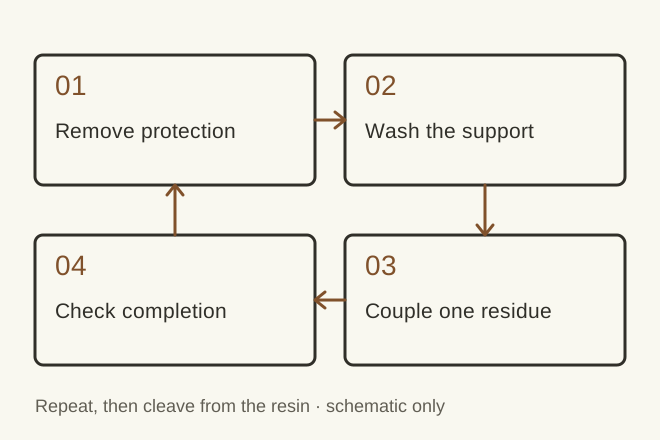
The described route uses Fmoc (a temporary chemical protecting group) solid-phase peptide synthesis. Resin selection determines the terminal group, while protected side chains allow the backbone to be assembled without unwanted reactions. Coupling and deprotection monitoring help identify failures before the whole chain is cleaved.
DAC attachment adds an identity question beyond chain assembly. The manufacturing record needs evidence for the intended modification and for unmodified or incorrectly modified material. The earlier cleavage, precipitation and washing sections describe recovery of a crude product, not finished-product release.
What purification must separate
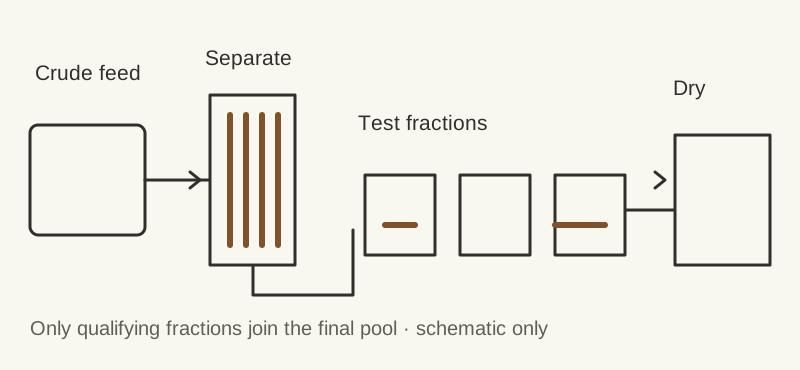
Preparative RP-HPLC (reversed-phase high-performance liquid chromatography, which separates mixture components) separates the target from related chains and process residues. Analytical scouting establishes a useful separation before a larger column is used. The gradient schedule below is an inherited example; column loading, flow and collection windows depend on the qualified process.
Fractions need both purity and identity review before pooling. Desalting and counterion exchange reduce mobile-phase residues. Formulation, filling and freeze-drying then require their own controls for moisture, cake structure and container closure; those operations cannot repair the wrong molecular form.
What release testing can establish
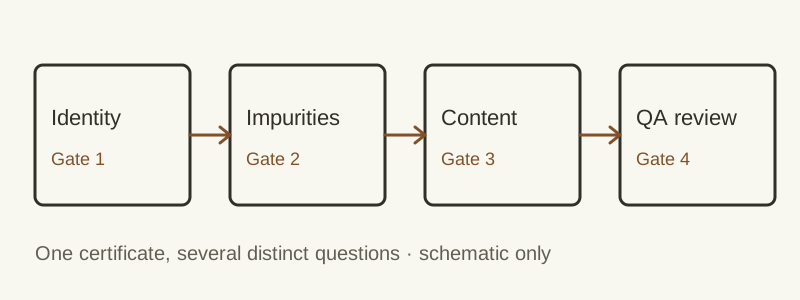
Identity testing should resolve the exact form being claimed. The earlier profile combines mass spectrometry, chromatographic comparison and composition checks, then adds purity, content and physical testing. Orthogonal methods are methods based on different measurement principles.
Related-peptide analysis, size-exclusion chromatography for larger species, residual-solvent testing and microbiological methods address separate risks. The sample CoA in the appendix is a formatting example with illustrative values. It is not an observed result for CJC-1295 from any supplier.
Where stability can be lost
Aggregation, oxidation and deamidation are the main stability topics in the earlier edition. Aggregation joins molecules into larger species; deamidation changes certain side chains. The study design tracks those changes rather than relying only on appearance.
Powder storage, container-closure qualification, environmental monitoring and shipping excursions belong in the stability programme. A retest date must be supported by data for the actual formulation. The earlier discussion of post-approval monitoring is a general pharmaceutical workflow, not evidence that this research material is approved.
What the batch record must show
The master batch record is the approved plan; the executed batch record shows what actually happened. Reagent lots, times, temperatures, in-process tests, yields and deviations should reconcile with the final quantity released. Corrective and preventive action, or CAPA, records how a problem was investigated and recurrence addressed.
FDA’s page current as of April 22, 2026 lists CJC-1295 among substances nominated but withdrawn. That status is not clearance for compounding or an approval for human use. The public Oath listing does not establish which CJC-1295 form or individual lot meets a project’s specification.
Technical tables & working schedules
CJC-1295 tables retain the earlier manufacturing examples. No CJC-1295 table here validates an operating procedure, release limit or supplier result. The CJC-1295 examples have no supporting batch raw data; use them to identify document fields, not to infer measured performance.
Coupling Cycle Parameters6 rows
Inherited manufacturing example. CJC-1295 settings in this table are unvalidated examples, not supplier specifications or batch results. The CJC-1295 process and its measurement methods need separate qualification.
| Parameter | Specification | Monitoring Method |
|---|---|---|
| Amino Acid Excess | 3.0 equivalents ± 0.2 | Gravimetric verification |
| Activation Time | 2-5 minutes | Process timing validation |
| Coupling Duration | 45-60 minutes | Automated synthesis monitoring |
| Temperature Control | 20-25°C ± 2°C | Continuous temperature monitoring |
| DMF Quality | Peptide synthesis grade, <0.005% water | Karl Fischer analysis per batch |
| Coupling Efficiency | >99.5% by Kaiser test | Colorimetric ninhydrin assay |
Cleavage Process Parameters5 rows
Inherited manufacturing example. CJC-1295 settings in this table are unvalidated examples, not supplier specifications or batch results. The CJC-1295 process and its measurement methods need separate qualification.
| Parameter | Specification | Critical Quality Impact |
|---|---|---|
| Cleavage Duration | 2-4 hours | Complete deprotection without excessive degradation |
| Temperature | 20-25°C ± 2°C | Minimize oxidation and deletion sequences |
| Cocktail Volume | 10-15 mL/g resin | Adequate scavenger capacity and mixing |
| Resin Separation | Complete filtration within 15 minutes | Minimize peptide exposure to acidic conditions |
| TFA Removal | Rotary evaporation at <30°C | Prevent thermal degradation during concentration |
Gradient Optimization and Method Parameters6 rows
Inherited manufacturing example. CJC-1295 settings in this table are unvalidated examples, not supplier specifications or batch results. The CJC-1295 process and its measurement methods need separate qualification.
| Time (min) | %B | Flow Rate (mL/min) | Purpose |
|---|---|---|---|
| 0-5 | 20 | 50 | Initial equilibration and sample loading |
| 5-10 | 20-25 | 50 | Wash highly polar impurities |
| 10-40 | 25-35 | 50 | Shallow gradient for critical separation |
| 40-50 | 35-95 | 50 | Steep gradient for hydrophobic impurities |
| 50-55 | 95 | 50 | Column wash |
| 55-65 | 95-20 | 50 | Re-equilibration |
Vial Filling Operations5 rows
Inherited manufacturing example. CJC-1295 settings in this table are unvalidated examples, not supplier specifications or batch results. The CJC-1295 process and its measurement methods need separate qualification.
| Parameter | Specification | Quality Assurance |
|---|---|---|
| Fill Volume Accuracy | ±5% of target volume | Gravimetric verification every 10 vials |
| Vial Type | Type I borosilicate glass, 5-10 mL | Certificate of analysis from vendor |
| Stopper Type | Fluoropolymer-coated butyl rubber, 20 mm | Extractables/leachables testing |
| Seal Integrity | Vacuum hold test: <100 μm Hg loss in 60 seconds | 100% inspection post-lyophilization |
| Particulate Matter | Zero visible particles per USP <790> | Visual inspection under controlled lighting |
Content and Potency Assays4 rows
Inherited manufacturing example. CJC-1295 settings in this table are unvalidated examples, not supplier specifications or batch results. The CJC-1295 process and its measurement methods need separate qualification.
| Method | Principle | Specification |
|---|---|---|
| Quantitative HPLC | External standard calibration at 214 nm | 90-110% of label claim |
| UV Spectroscopy | Absorbance at 280 nm using extinction coefficient | Supporting data for HPLC results |
| Amino Acid Analysis | Quantitation of hydrolyzed amino acids vs. standards | Confirmatory method, 85-115% agreement |
| Nitrogen Determination | Kjeldahl or combustion analysis for peptide nitrogen | Alternative quantitation, ±15% of expected |
In-Process Control Strategy6 rows
Inherited manufacturing example. CJC-1295 settings in this table are unvalidated examples, not supplier specifications or batch results. The CJC-1295 process and its measurement methods need separate qualification.
| Manufacturing Stage | In-Process Control | Frequency | Action on OOS Result |
|---|---|---|---|
| Solid-Phase Synthesis | Kaiser test after coupling | Each cycle | Repeat coupling until negative |
| Solid-Phase Synthesis | UV monitoring at 301 nm | Each deprotection | Extend deprotection time |
| Cleavage | Reaction time verification | Continuous | Extend within validated range |
| Purification | Fraction purity by HPLC | Each fraction | Exclude from pool or re-purify |
| Lyophilization | Pressure/temperature monitoring | Continuous recording | Investigate cycle failure, may reprocess |
| Fill/Finish | Fill weight verification | Every 10th vial | Adjust fill volume, recheck |
Stability-Indicating Test Methods8 rows
Inherited manufacturing example. CJC-1295 settings in this table are unvalidated examples, not supplier specifications or batch results. The CJC-1295 process and its measurement methods need separate qualification.
| Test | Method | Acceptance Criteria at Release | Shelf-Life Specification |
|---|---|---|---|
| Appearance | Visual inspection | White to off-white powder | No significant color change |
| Identification | HPLC retention time, MS | Matches reference standard | Matches reference standard |
| Purity (HPLC) | RP-HPLC at 214 nm | ≥95.0% | ≥92.0% |
| Assay | Quantitative HPLC | 95.0-105.0% | 90.0-110.0% |
| Aggregates | SEC-HPLC | ≤3.0% | ≤5.0% |
| Water Content | Karl Fischer | ≤3.0% | ≤5.0% |
| Oxidation Products | RP-HPLC peak tracking | ≤1.0% individual | ≤2.0% individual |
| Deamidation Products | Ion-exchange HPLC | ≤2.0% | ≤4.0% |
Environmental Monitoring Programs4 rows
Inherited manufacturing example. CJC-1295 settings in this table are unvalidated examples, not supplier specifications or batch results. The CJC-1295 process and its measurement methods need separate qualification.
| Storage Area | Monitoring Parameters | Frequency | Action Limits |
|---|---|---|---|
| Freezer (-20°C) | Temperature | Continuous recording, 15-min intervals | Alert: -23°C or -17°C; Action: -25°C or -15°C |
| Refrigerator (2-8°C) | Temperature | Continuous recording, 15-min intervals | Alert: <1°C or >9°C; Action: <0°C or >10°C |
| Controlled Room Temperature | Temperature, RH | Continuous recording, 30-min intervals | Alert: <18°C or >27°C; Action: <15°C or >30°C |
| All storage areas | Light exposure | Annual verification | No direct sunlight, <200 lux ambient |
Analytical Test Results Table11 rows
Illustrative record retained from the earlier edition. These CJC-1295 examples have no verified measurement dataset and cannot establish a batch result or supplier performance.
| Test | Method | Specification | Result |
|---|---|---|---|
| Appearance | Visual | White to off-white powder | White lyophilized powder |
| Identity (HPLC) | RP-HPLC | RT matches standard ±2% | Conforms (RT: 24.3 min) |
| Identity (MS) | ESI-MS | MW: 3647.3 ±0.5 Da | 3647.4 Da |
| Purity (HPLC) | RP-HPLC at 214 nm | ≥95.0% | 97.2% |
| Assay (Content) | Quantitative HPLC | 95.0-105.0% | 98.7% |
| Water Content | Karl Fischer | ≤5.0% | 2.1% |
| Acetonitrile | GC | ≤410 ppm | <50 ppm |
| TFA | Ion chromatography | ≤0.5% | 0.08% |
| Heavy Metals | ICP-MS | ≤10 ppm | <2 ppm |
| Bacterial Endotoxins | LAL | ≤5.0 EU/mg | <0.5 EU/mg |
| Sterility | USP <71> | Passes | No growth detected |
Source register
CJC-1295 source links are retained below. These references give context for CJC-1295 manufacturing; they do not validate the numerical examples. Duplicate CJC-1295 source links retain the citation record.
- cGMP regulations for peptide therapeutics
- ICH Q7 guidelines for API manufacturing
- USP harmonization standards for peptide purification
- FDA guidance on lyophilization of parenteral products
- ICH Q3B guidance on impurities in new drug substances
- USP <1225> validation of compendial procedures
- Oath Research's public lab-results archive
- FDA quality systems guidance
- Extractables and leachables studies per USP <1663> and <1664>
- FDA Drug Supply Chain Security Act requirements
- FDA cGMP requirements
- U.S. Food and Drug Administration. (2023). Current Good Manufacturing Practice (CGMP) Regulations for Drugs. 21 CFR Parts 210 and 211. Available at: https://www.fda.gov/drugs/pharmaceutical-quality-resources/current-good-manufacturing-practice-cgmp-regulations
- International Council for Harmonisation (ICH). (2023). ICH Q7: Good Manufacturing Practice Guide for Active Pharmaceutical Ingredients. Available at: https://www.ich.org/page/quality-guidelines
- U.S. Food and Drug Administration. (2022). Guidance for Industry: Lyophilization of Parenteral Products. Center for Drug Evaluation and Research. Available at: https://www.fda.gov/regulatory-information/search-fda-guidance-documents/guidance-industry-lyophilization-parenteral-products
- United States Pharmacopeia. (2024). USP Harmonization Standards for Peptide Manufacturing. USP-NF General Chapters. Available at: https://www.usp.org/harmonization-standards/pdg
- International Council for Harmonisation (ICH). (2023). ICH Q3B(R2): Impurities in New Drug Substances. Available at: https://www.ich.org/page/quality-guidelines
- United States Pharmacopeia. (2024). USP <1225> Validation of Compendial Procedures. Available at: https://www.usp.org/validation
- United States Pharmacopeia. (2024). USP <1663> Assessment of Extractables Associated with Pharmaceutical Packaging/Delivery Systems and USP <1664> Assessment of Drug Product Leachables Associated with Pharmaceutical Packaging/Delivery Systems. Available at: https://www.usp.org/chemical-medicines/general-chapters
- U.S. Food and Drug Administration. (2021). Drug Supply Chain Security Act (DSCSA). Available at: https://www.fda.gov/drugs/drug-approvals-and-databases/drug-supply-chain-security-act-dscsa
- U.S. Food and Drug Administration. (2006). Guidance for Industry: Quality Systems Approach to Pharmaceutical CGMP Regulations. Available at: https://www.fda.gov/regulatory-information/search-fda-guidance-documents/guidance-industry-quality-systems-approach-pharmaceutical-cgmp-regulations
- U.S. Food and Drug Administration. (2023). Facts about the Current Good Manufacturing Practices (CGMPs). Available at: https://www.fda.gov/drugs/pharmaceutical-quality-resources/facts-about-current-good-manufacturing-practices-cgmps