What has to be made
BPC-157 is the synthetic 15-amino-acid sequence described in the earlier profile as a fragment associated with body protection compound. A sequence is the ordered list of amino acids, the building blocks of a peptide. The identity specification also needs to say which terminal groups and counterion form are being measured.
The earlier tables include a free-acid molecular weight and several example quality limits. They are retained below as reference examples. A theoretical mass, a chromatographic purity result and a biological effect are different claims; none can substitute for the others.
How the chain is assembled
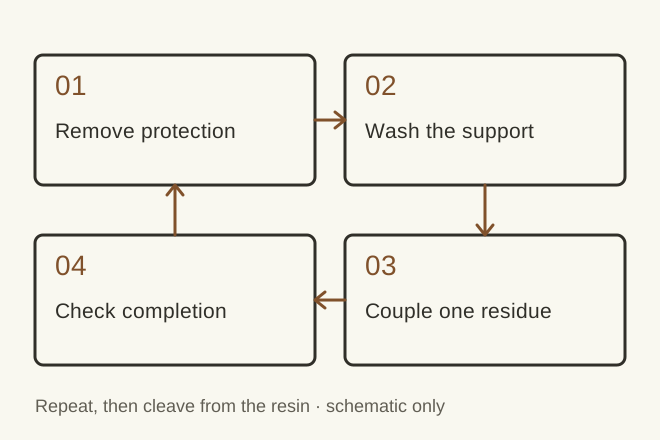
Solid-phase peptide synthesis, or SPPS, builds the chain while one end is attached to a resin bead. The earlier route uses Fmoc protection: a temporary cap is removed so that the next protected amino acid can be joined. Wang-type supports and an alternative Boc route are discussed in that edition.
The proline-rich sequence makes completeness of each coupling worth checking. The record should connect resin loading, reagent lots, reaction monitoring and any repeated coupling with the eventual impurity profile. Cleavage releases the peptide from its support; scavengers capture reactive fragments from the removed protecting groups.
What purification must separate
Reversed-phase high-performance liquid chromatography, shortened to RP-HPLC, separates the crude mixture by how its components interact with the column. The older process uses a C18 column and a water–acetonitrile gradient. A gradient changes the solvent mixture during a run.
Deletion sequences, which are chains missing one or more residues, need to be separated before fractions are pooled. Further polishing, desalting and counterion exchange address different problems from sequence purity. Freeze-drying, also called lyophilization, removes solvent from the selected pool. Recovery and purity need separate accounting.
What release testing can establish
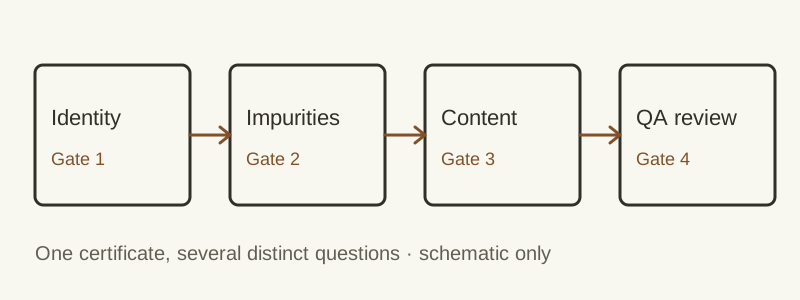
Mass spectrometry checks molecular mass; amino acid analysis checks composition. Analytical HPLC estimates the relative sizes of detected peaks. Peptide content asks how much of the weighed material is actually peptide after accounting for water, salts and other material. A high peak-area percentage is not a content result.
The earlier panel also covers related substances, water, residual solvents, counterions, elemental impurities, bioburden and endotoxin. Bioburden is a count of living microbes; endotoxin is bacterial material measured by a different test. Its example limits are not evidence that any offered batch passed them.
Where stability can be lost
The earlier stability plan compares frozen and refrigerated powder with warmer, humid and light-exposed samples. It also discusses freeze–thaw stress. These are ways to challenge a material, not proof of a universal shelf life. The relevant endpoint is change in a qualified analytical method for the actual container.
The storage and shipping examples retain the powder and cold-chain topics. Solution stability requires its own evidence; powder stability cannot establish how long a prepared solution remains suitable.
What the batch record must show
A usable record links raw materials, equipment, in-process checks, purification fractions, drying data and the final certificate of analysis, or CoA. It needs the actual results, method references, deviations and an authorised release decision. Changes in mixing, loading or drying during scale-up need evaluation rather than a copied timetable.
On FDA’s page current as of April 22, 2026, BPC-157 is listed among substances nominated but withdrawn. Withdrawal is not approval or clearance, and the stated safety concerns remain. Manufacturing documentation does not turn research material into an approved medicine.
Technical tables & working schedules
BPC-157 tables retain the earlier manufacturing examples. No BPC-157 table here validates an operating procedure, release limit or supplier result. The BPC-157 examples have no supporting batch raw data; use them to identify document fields, not to infer measured performance.
BPC-157 Product Specifications Summary10 rows
Inherited manufacturing example. BPC-157 settings in this table are unvalidated examples, not supplier specifications or batch results. The BPC-157 process and its measurement methods need separate qualification. The inherited counterion label mixes acetate with a TFA salt; the form and limit require a corrected material-specific specification.
| Parameter | Specification | Test Method |
|---|---|---|
| Molecular Formula | C62H98N16O22 | Mass Spectrometry |
| Molecular Weight | 1419.53 g/mol (free acid) | ESI-MS, MALDI-TOF |
| Sequence | Gly-Glu-Pro-Pro-Pro-Gly-Lys-Pro-Ala-Asp-Asp-Ala-Gly-Leu-Val | Amino Acid Analysis |
| Purity (HPLC) | ≥98.0% | RP-HPLC/UPLC (UV 214nm) |
| Net Peptide Content | ≥85.0% | Amino Acid Analysis |
| Water Content | ≤8.0% | Karl Fischer Titration |
| Acetate Content (TFA salt) | ≤15.0% | Ion Chromatography |
| Endotoxin Level | <1.0 EU/mg | LAL Assay (USP <85>) |
| Bioburden | <10 CFU/g | USP <61>/<62> |
| Storage Conditions | -20°C ± 5°C, desiccated | N/A |
SPPS Cycle Parameters for BPC-157 Synthesis7 rows
Inherited manufacturing example. BPC-157 settings in this table are unvalidated examples, not supplier specifications or batch results. The BPC-157 process and its measurement methods need separate qualification.
| Process Step | Reagent/Conditions | Duration | Cycles |
|---|---|---|---|
| Resin Swelling | DMF, room temperature | 30 min | 1x (initial) |
| Fmoc Deprotection | 20% piperidine/DMF | 3 min + 5 min | 2x per AA |
| Washing | DMF (3x), DCM (2x) | 1 min each | 5x per AA |
| Coupling Reaction | Fmoc-AA (4 eq), HBTU (3.95 eq), DIEA (6 eq) in DMF | 45-60 min | 1-2x per AA |
| Capping (optional) | Ac2O/DIEA/DMF (5:6:89) | 5 min | 1x if incomplete |
| Kaiser Test | Ninhydrin reagent, 105°C | 5 min | After each coupling |
| Final Cleavage | TFA/H2O/TIS (95:2.5:2.5) | 2-3 hours | 1x (final) |
Preparative HPLC Purification Parameters11 rows
Inherited manufacturing example. BPC-157 settings in this table are unvalidated examples, not supplier specifications or batch results. The BPC-157 process and its measurement methods need separate qualification.
| Parameter | Specification | Notes |
|---|---|---|
| Column Stationary Phase | C18, 10-20 μm, 100-300 Å | Preparative-scale RP media |
| Column Dimensions | Not published | Scalable to 250 x 100 mm |
| Mobile Phase A | Water + 0.1% TFA | HPLC-grade solvents |
| Mobile Phase B | Acetonitrile + 0.1% TFA | HPLC-grade solvents |
| Gradient Profile | 10-50% B over 60-90 min | Optimized for resolution |
| Flow Rate | 50-200 mL/min | Scale-dependent |
| UV Detection | 214 nm, 220 nm | Peptide bond absorbance |
| Column Temperature | Ambient or 40°C | Temperature-controlled |
| Loading Capacity | 10-50 mg/g stationary phase | Crude peptide mass |
| Collection Purity | ≥95% (analytical HPLC) | Pre-pooling verification |
| Recovery yield evidence | Not published | From crude to purified |
Analytical Testing Methods and Specifications13 rows
Inherited manufacturing example. BPC-157 settings in this table are unvalidated examples, not supplier specifications or batch results. The BPC-157 process and its measurement methods need separate qualification.
| Test | Method | Specification | USP Reference |
|---|---|---|---|
| Appearance | Visual Inspection | White to off-white lyophilized powder | N/A |
| Identity (MS) | ESI-MS or MALDI-TOF | 1419.53 ± 0.5 Da (free acid) | N/A |
| Identity (AAA) | Amino Acid Analysis | Conforms to theoretical composition | <1226> |
| Purity (HPLC) | RP-HPLC, UV 214nm | ≥98.0% (area normalization) | <621> |
| Related Substances | RP-HPLC, UV 214nm | Any impurity ≤1.0%, Total ≤2.0% | <621> |
| Net Peptide Content | Amino Acid Analysis | ≥85.0% | <1226> |
| Water Content | Karl Fischer Titration | ≤8.0% | <921> |
| TFA Content | Ion Chromatography | ≤15.0% (TFA salt) | N/A |
| Residual Solvents | GC-HS (Headspace GC) | Per ICH Q3C limits | <467> |
| Heavy Metals | ICP-MS | ≤10 ppm total | <232>/<233> |
| Bioburden | Membrane Filtration | <10 CFU/g (TAMC), <10 CFU/g (TYMC) | <61>/<62> |
| Endotoxin | LAL Assay (Kinetic) | <1.0 EU/mg | <85> |
| Specific Rotation | Polarimetry | Report value | <781> |
Critical Process Parameters and In-Process Controls10 rows
Inherited manufacturing example. BPC-157 settings in this table are unvalidated examples, not supplier specifications or batch results. The BPC-157 process and its measurement methods need separate qualification.
| Process Stage | Critical Parameter | Specification/Range | Control Method |
|---|---|---|---|
| Synthesis | Coupling Efficiency | ≥99% per cycle | Kaiser Test (ninhydrin) |
| Synthesis | Fmoc Deprotection | Complete (UV baseline) | UV monitoring at 301 nm |
| Synthesis | Crude Purity (HPLC) | ≥50% target peptide | Analytical HPLC |
| Purification | Fraction Purity | ≥95% (analytical HPLC) | HPLC verification pre-pooling |
| Purification | Column Performance | Resolution ≥2.0 (main/impurity) | System suitability testing |
| Purification | Recovery Yield | ≥60% (crude to purified) | Mass balance calculation |
| Lyophilization | Residual Moisture | ≤8.0% | Karl Fischer (post-lyo) |
| Lyophilization | Cake Appearance | Uniform, no collapse | Visual inspection |
| Environmental | Cleanroom Class | ISO 7 or better | Particle counting |
| Environmental | Bioburden Monitoring | Action limits per SOP | Settle plates, surface sampling |
ICH Stability Testing Conditions and Parameters7 rows
Inherited manufacturing example. BPC-157 settings in this table are unvalidated examples, not supplier specifications or batch results. The BPC-157 process and its measurement methods need separate qualification.
| Study Type | Storage Condition | Duration | Testing Intervals |
|---|---|---|---|
| Long-Term | -20°C ± 5°C (primary) | 36 months minimum | 0, 3, 6, 9, 12, 18, 24, 36 months |
| Long-Term (alternative) | 2-8°C ± 2°C | 36 months minimum | 0, 3, 6, 9, 12, 18, 24, 36 months |
| Accelerated | 25°C ± 2°C / 60% ± 5% RH | 6 months | 0, 1, 2, 3, 6 months |
| Intermediate | 5°C or 15°C | 12 months | 0, 3, 6, 9, 12 months |
| Stress (thermal) | 40°C / 75% RH | 1-3 months | 0, 1, 2, 3 months |
| Stress (freeze-thaw) | -20°C to +25°C cycles | 5 cycles | After each cycle |
| Photostability | ICH Q1B conditions | Single timepoint | Post-exposure (1.2M lux·hr, 200 W·hr/m²) |
Storage and Shipping Requirements Summary9 rows
Inherited manufacturing example. BPC-157 settings in this table are unvalidated examples, not supplier specifications or batch results. The BPC-157 process and its measurement methods need separate qualification.
| Parameter | Specification | Monitoring/Verification |
|---|---|---|
| Storage Temperature (lyophilized) | -20°C ± 5°C | Continuous temperature monitoring |
| Storage Temperature (alternative) | 2-8°C ± 2°C | Continuous temperature monitoring |
| Storage Humidity | Desiccated (<20% RH) | Desiccant packets in packaging |
| Light Protection | Amber glass or protective packaging | Visual verification |
| Primary Container | Type I borosilicate glass vials | Per USP <660> |
| Closure System | Butyl rubber stopper + aluminum seal | Container closure integrity testing |
| Shipping Temperature | -20°C (dry ice) or 2-8°C (gel packs) | Temperature data loggers |
| Shipping Duration | ≤72 hours (validated shipping) | Carrier transit time verification |
| Documentation | Chain of custody, CoA, storage logs | Batch record retention |
Certificate of Analysis Parameters for BPC-15718 rows
Illustrative record retained from the earlier edition. These BPC-157 examples have no verified measurement dataset and cannot establish a batch result or supplier performance.
| CoA Section | Required Information | Data Source |
|---|---|---|
| Product Identification | Product Name: BPC-157 (peptide) | Product specification |
| Product Identification | Batch/Lot Number: Unique identifier | Batch manufacturing record |
| Product Identification | Manufacturing Date: MM/YYYY | Batch manufacturing record |
| Product Identification | Expiration/Retest Date: MM/YYYY | Stability data + shelf life |
| Product Identification | Storage: -20°C ± 5°C, desiccated | Product specification |
| Chemical Properties | Sequence: GEPPPGKPADDAGLV | Product specification |
| Chemical Properties | Molecular Formula: C₆₂H₉₈N₁₆O₂₂ | Theoretical calculation |
| Chemical Properties | Molecular Weight: 1419.53 g/mol | Theoretical calculation |
| Analytical Testing | Appearance: White to off-white powder | Visual inspection |
| Analytical Testing | Identity (MS): Expected vs. Observed MW | ESI-MS or MALDI-TOF |
| Analytical Testing | Purity (HPLC): ≥98.0% (actual: X.X%) | RP-HPLC (UV 214nm) |
| Analytical Testing | Net Peptide Content: ≥85.0% (actual: X.X%) | Amino acid analysis |
| Analytical Testing | Water Content: ≤8.0% (actual: X.X%) | Karl Fischer |
| Analytical Testing | TFA Content: ≤15.0% (actual: X.X%) | Ion chromatography |
| Analytical Testing | Endotoxin: <1.0 EU/mg (actual: X.X EU/mg) | LAL assay |
| Analytical Testing | Bioburden: <10 CFU/g (actual: <X CFU/g) | Membrane filtration |
| Quality Assurance | QC Approval: Name, signature, date | QC manager authorization |
| Quality Assurance | Conformance Statement: Meets specifications | QC verification |
Applicable Regulatory Guidelines and Standards11 rows
Inherited manufacturing example. BPC-157 settings in this table are unvalidated examples, not supplier specifications or batch results. The BPC-157 process and its measurement methods need separate qualification.
| Regulatory Area | Applicable Guideline | Key Requirements |
|---|---|---|
| API Manufacturing | ICH Q7 | cGMP for active pharmaceutical ingredients |
| Finished Products | FDA 21 CFR Part 211 | cGMP for finished pharmaceuticals |
| Analytical Validation | ICH Q2(R1) | Validation of analytical procedures |
| Stability Testing | ICH Q1A(R2), Q1B | Stability testing protocols and photostability |
| Impurities | ICH Q3A, Q3B(R2), Q3C | Impurities in new drug substances/products, residual solvents |
| Quality Risk Management | ICH Q9 | Risk-based approach to quality |
| Pharmaceutical Quality Systems | ICH Q10 | Quality management systems |
| Peptide-Specific | USP <1226> | Verification of compendial procedures for peptides |
| Sterility Testing | USP <71>, ISO 11737 | Sterility tests for injectable products |
| Endotoxin Testing | USP <85>, FDA guidance | Bacterial endotoxins testing |
| Container Closure | USP <1207> | Package integrity evaluation |
Process Optimization Parameters and Targets13 rows
Inherited manufacturing example. BPC-157 settings in this table are unvalidated examples, not supplier specifications or batch results. The BPC-157 process and its measurement methods need separate qualification.
| Process Stage | Optimization Parameter | Development Target | Impact |
|---|---|---|---|
| Synthesis | Coupling Efficiency | >99.5% per cycle | Reduce deletion sequences |
| Synthesis | Coupling Time | 15-30 min (microwave) vs. 45-60 min (conventional) | Increase throughput |
| Synthesis | Reagent Excess | 3-4 equivalents (optimized) vs. 5-10 eq (excess) | Reduce cost, waste |
| Synthesis | Crude Purity | >60% target peptide | Improve purification efficiency |
| Purification | Gradient Slope | 0.3-0.5% B/min (optimized) | Maximize resolution |
| Purification | Column Loading | 30-50 mg crude/g media | Balance yield/purity/throughput |
| Purification | Recovery Yield | >70% (crude to purified) | Economic viability |
| Purification | Solvent Consumption | Minimize while maintaining resolution | Reduce cost, environmental impact |
| Lyophilization | Cycle Time | 36-48 hours (optimized) vs. 72+ hours | Increase throughput |
| Lyophilization | Residual Moisture | 3-5% (target) vs. <8% (limit) | Improve stability |
| Lyophilization | Cake Appearance | Uniform, no collapse | Reconstitution performance |
| Overall Process | Total Manufacturing Time | 6-8 days (optimized) vs. 10-12 days | Capacity utilization |
| Overall Process | Cost of Goods (COG) | 30-50% reduction through optimization | Commercial viability |
Source register
BPC-157 source links are retained below. These references give context for BPC-157 manufacturing; they do not validate the numerical examples. Duplicate BPC-157 source links retain the citation record.
- FDA ICH Q1A(R2) guidelines
- ICH stability testing requirements
- advanced SPPS optimization literature
- industrial peptide manufacturing guides
- USP peptide monographs
- FDA analytical validation guidance
- FDA data integrity guidance
- ICH stability guidance documents
- WHO good storage practices
- FDA batch production record guidance
- Oath Research
- FDA IND guidance
- EMA quality guidelines
- green chemistry principles
- U.S. Food and Drug Administration. "ICH Q1A(R2): Stability Testing of New Drug Substances and Products." https://www.fda.gov/media/71707/download
- International Council for Harmonisation. "ICH Quality Guidelines." https://database.ich.org
- American Chemical Society, Organic Letters. "High-Efficiency Solid Phase Peptide Synthesis (HE-SPPS)." https://pubs.acs.org/journal/orlef7
- Bachem AG. "Peptide Manufacturing and Quality Control Guide." https://www.bachem.com/knowledge-center/peptide-guide/
- United States Pharmacopeia. "USP Peptide Monographs and General Chapters." https://www.usp.org
- U.S. Food and Drug Administration. "Q2(R1): Validation of Analytical Procedures - Text and Methodology." https://www.fda.gov/regulatory-information/search-fda-guidance-documents/q2r1-validation-analytical-procedures-text-and-methodology
- U.S. Food and Drug Administration. "Data Integrity and Compliance With Drug CGMP - Questions and Answers." https://www.fda.gov/regulatory-information/search-fda-guidance-documents/data-integrity-and-compliance-drug-cgmp-questions-and-answers
- World Health Organization. "TRS 961, Annex 9: Good Storage Practices for Pharmaceuticals." https://www.who.int/publications/m/item/trs-961-annex-9
- U.S. Food and Drug Administration. "Batch Production and Control Records Guidance." https://www.fda.gov/media/73830/download
- U.S. Food and Drug Administration. "Investigational New Drug (IND) Application." https://www.fda.gov/drugs/development-approval-process-drugs/investigational-new-drug-ind-application
- European Medicines Agency. "Quality Guidelines - Multidisciplinary." https://www.ema.europa.eu/en/human-regulatory/research-development/scientific-guidelines/multidisciplinary/multidisciplinary-quality
- American Chemical Society. "Green Chemistry Principles and Practice." https://www.acs.org/greenchemistry